What this is. Opinion + Experience + Fact (30% opinion · 40% experience · 30% fact). Written in collaboration with AI — I discuss, I do not outsource.
Why you should never push a firmware update to an entire fleet at once — and how a canary (staged) rollout limits the blast radius. The short version: at fleet scale, "deploy" and "incident" can be the same action. Update 1% first, watch whether it's healthy, and widen only on evidence.
On the bench, "deploy" is a small word. One board picks up new firmware, you poke at it, you move on. In the field, the same word can mean ten thousand devices change at the same moment — and if the new build has a regression, you didn't deploy an update, you triggered an outage. Same button, wildly different blast radius.
After shipping updates to fleets that don't tolerate mistakes, I've stopped thinking of a fleet update as a deploy and started thinking of it as a controlled release. Here's the shape of that, and where it quietly depends on being able to see your devices.
1. One bad update reaches everyone at once
The defining property of a fleet-wide update is that its blast radius is the entire fleet. A regression you'd shrug off on a single device on your desk — a crash on boot, a radio that won't reconnect, a config migration that corrupts state — becomes a field-wide incident the instant it lands everywhere simultaneously. And unlike a server you can roll back in seconds, a field device that won't boot or won't connect may be genuinely hard to recover, because the very channel you'd use to fix it is the one the bad update broke.
This is why a fleet update deserves more caution than a web deploy, not less. The cost of being wrong isn't a red build — it's a truck roll, or a bricked product in a customer's hands. (It's the same reason losing the network has to be treated as part of the spec.)
▸ First principle. At fleet scale, "deploy" and "incident" can be the same action.
2. Update 1% before you update 100%
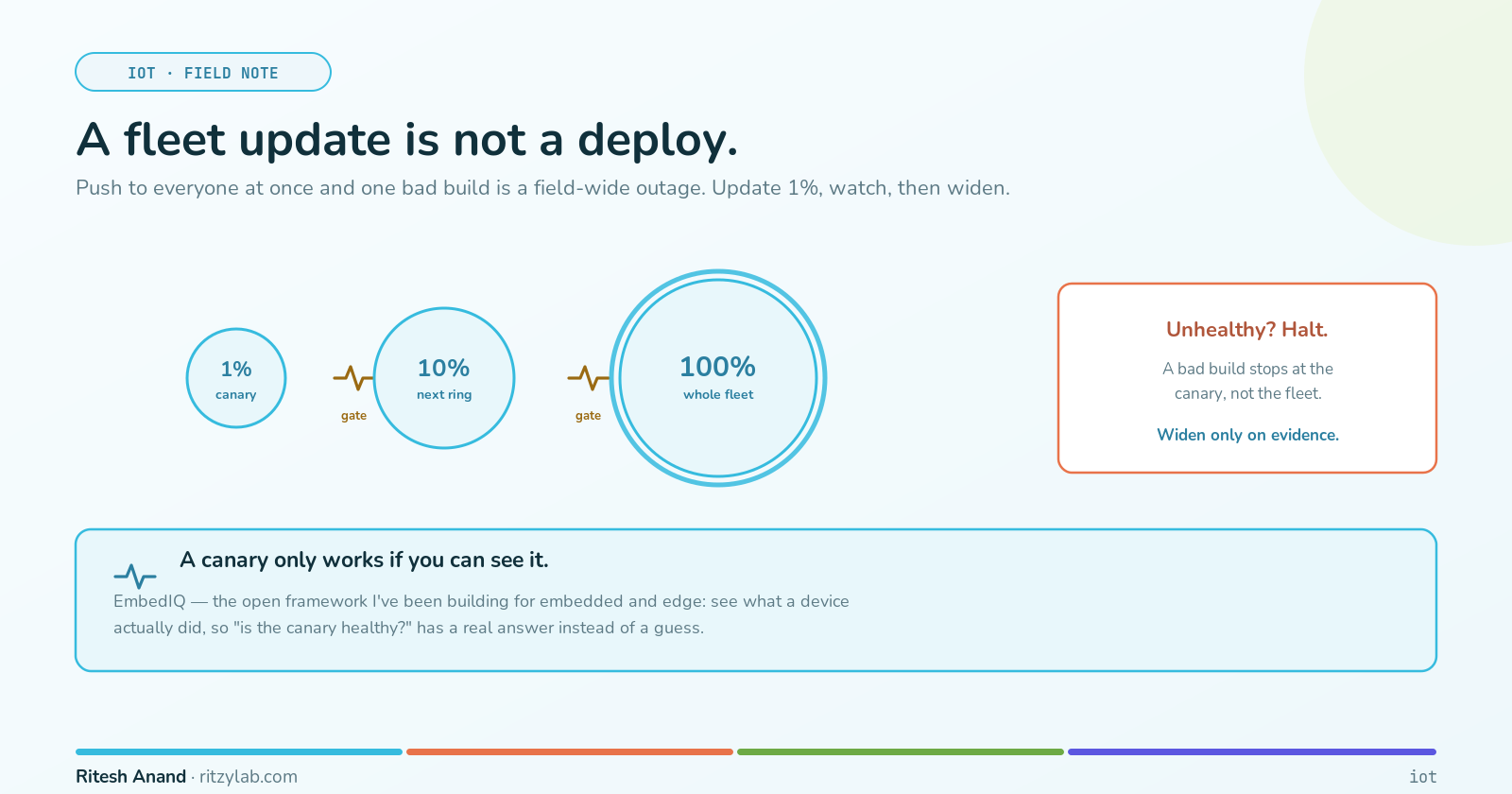
The fix is a canary — a staged, or phased, rollout. A small cohort of the fleet gets the update first. You watch that cohort. Only if it stays healthy do you widen to the next ring, then the next, until the update reaches everyone. The whole point is to catch a bad build on 1% of the fleet, where it's a contained nuisance, rather than on 100%, where it's a headline and a recovery operation.
This isn't exotic; it's the fleet equivalent of a canary deploy in web operations, and every serious fleet-update system supports some form of phased rollout with cohorts and pause/resume. The discipline is in actually using it — resisting the temptation to push to everyone because the update "looks fine," and letting the first cohort earn the rest of the rollout.
▸ First principle. You learn whether an update is safe from the first cohort, not the last.
3. A canary only works if you can see it
Here's the part that's easy to skip and expensive to skip: a staged rollout is only as good as your ability to tell whether the canary cohort is actually healthy. If "watch it" means glancing at whether the devices are still online, you'll miss the update that boots fine but drops sensor readings, or reconnects but drains the battery twice as fast. Without real visibility into what the updated devices are doing, you're not running a canary — you're just updating slowly and hoping. The staging bought you nothing.
That visibility starts on the device. It's what EmbedIQ, the open (Apache-2.0) framework I've been building for embedded and edge, is for: a zero-instrumentation way to see what a device actually did at runtime, so a question like "is the canary healthy?" has a real answer instead of a guess. The rollout mechanics — cohorts, timers, pause and resume — are one half; being able to read the first cohort honestly is the other. (Deciding which few numbers actually tell you a fleet is healthy is the same problem, one ring earlier.)
▸ First principle. A staged rollout you can't observe is just a slow full rollout.
Sources
Canary and phased (staged) rollout are established practice for both software deployment and fleet/over-the-air firmware updates; the mechanics here — cohorts, health gates, pause/resume, blast-radius containment — are standard across fleet-update tooling. This piece is method and lived experience; it contains no product performance figures, and "1%", "10%", and "ten thousand" are illustrative of the pattern, not measured claims.
FAQ
Why shouldn't you update an entire device fleet at once?
Because the blast radius of a fleet-wide update is the entire fleet. A regression that would be trivial on one device becomes a field-wide incident when it lands on every device at the same time — and field devices can be far harder to recover than a server, since the bad update may break the very channel you'd use to fix it.
What is a canary (staged) rollout for firmware?
You release the update to a small cohort of the fleet first, watch whether that cohort stays healthy, and only widen to larger rings if it does. It catches a bad build on a small percentage of devices instead of all of them, and lets you halt before the damage is fleet-wide.
How do you decide it's safe to widen from 1% to 100%?
On evidence, not a timer alone. Define what "healthy" means — crash rate, connectivity, and the few metrics that matter for your product — and require the canary cohort to meet it before each expansion. If the metrics degrade, halt the rollout.
Why does a staged rollout depend on observability?
Because staging only helps if you can actually tell whether the canary is healthy. Without real visibility into what the updated devices are doing, you'll miss failures that don't take a device offline, and a canary you can't read is just a slow full rollout.
This is an IoT field note. If you're building the update path for a fleet and want a second set of eyes, the longer story and how I work live on my profile. — Ritesh | ritzylab.com
Stay in the loop
New essays on embedded systems, firmware quality, and engineering craft. No noise.
Discussion
No comments yet. Be the first to share your thoughts.
Leave a comment