What this is. Opinion + Experience + Fact (25% opinion · 35% experience · 40% fact). Written in collaboration with AI — I discuss, I do not outsource.
Why the SIM in a connected product is a product-level decision, not a purchasing one — and how permanent-roaming rules and eSIM change what you should design in. The short version: the SIM sets your coverage, cost, and legal right to operate; several countries restrict devices roaming indefinitely; and an eSIM you can re-provision over the air turns a regulatory wall into a software update.
There's a decision on every connected-product bill of materials that looks tiny and turns out to be enormous: the SIM. It's easy to treat it as a commodity — pick a global roaming plan, drop the SIM in, ship the device — because on the bench, and in the first demo, any SIM that connects looks like the right one. But the SIM quietly determines where your device can connect, what each device costs to keep online, and, less obviously, whether it's even legal to keep operating in a given country for the years your product will live there. That's a product decision wearing a purchasing disguise.
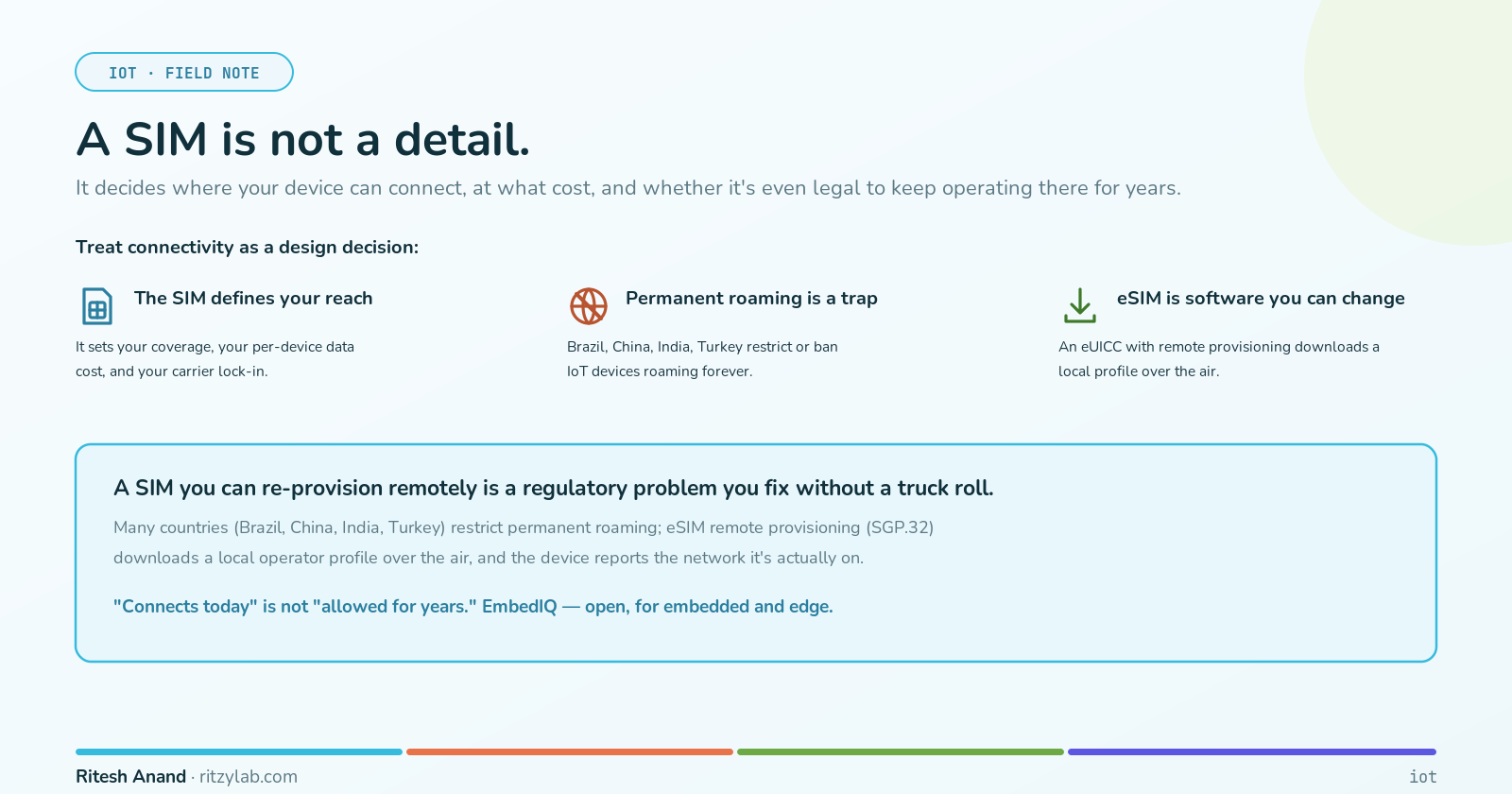
1. The SIM defines your device's reach
Connectivity is one of the few choices that touches coverage, cost, and risk all at once. The SIM (or the plan behind it) sets which networks your device can use, the per-device data cost at the scale you're planning for, and how exposed you are to a single carrier's pricing and lifecycle decisions. A global roaming SIM that "just works" everywhere on day one is genuinely convenient — and it can quietly become the most expensive and most fragile line in the bill of materials once you have thousands of units in the field. None of that is visible when you're holding one prototype; all of it is visible at scale.
▸ First principle. Connectivity is a design input, not a plug you add at the end.
2. Permanent roaming is a trap you meet after launch
Here's the part that surprises teams, because it has nothing to do with signal. A roaming SIM connects abroad immediately — but a number of countries restrict or prohibit devices from roaming permanently on a foreign network, among them Brazil, China, India, and Turkey. The enforcement varies: Brazil tolerates roughly 90 continuous days before a visited operator can cut a device's traffic, and expects a local SIM or an in-country profile beyond that; India does not permit permanent roaming for IoT and expects a locally licensed M2M provider for long-term operation. So a device designed to sit in one country for years can be disconnected by a regulation, not a radio — and you find out after it's deployed, which is the worst possible time.
▸ First principle. "Connects today" is not "allowed to operate here for five years."
3. eSIM turns the SIM into software you can change
The structural fix is to stop treating the SIM as a fixed piece of plastic. An eSIM — technically an eUICC — with remote provisioning can hold and switch operator profiles, and the IoT-focused SGP.32 standard is built to download a local operator profile over the air, without a truck roll and without re-manufacturing the device. That converts a permanent-roaming wall into a configuration change. But it only works if you plan for it early: where the eSIM is injected at the factory, how profiles get provisioned, and how you manage the SIM across the fleet's life — and, importantly, whether the profile you can download actually satisfies local rules, which depends on the operator and the provisioning setup, not just the hardware. The device should also report which network and profile it's actually on, so you can see connectivity problems across the fleet rather than guess — the kind of on-device visibility I build into EmbedIQ, my open framework for embedded and edge.
▸ First principle. A SIM you can re-provision remotely is a regulatory problem you can fix without touching the device.
Sources
Permanent-roaming restrictions (Brazil, China, India, Turkey), Brazil's approximate 90-day tolerance, India's requirement for a locally licensed M2M provider, and eSIM/eUICC remote provisioning via the SGP.32 standard are drawn from current IoT-connectivity guidance — see IoT Now on permanent roaming, IoT For All on network localization, and Thingsdata's permanent-roaming overview. Rules and tolerances change and vary by operator; verify for your countries and carriers before committing a design. This piece is method and lived experience; it contains no product performance figures.
FAQ
Why is the SIM a product decision, not just a purchase?
Because it determines your device's coverage, its per-device data cost at scale, your exposure to one carrier, and whether it's legal to keep operating in a given country for years. Those are design-level consequences, so the SIM should be chosen during design, not treated as a commodity added at the end.
What is permanent roaming, and where is it restricted?
Permanent roaming is a device operating indefinitely on a foreign network via a roaming SIM. Several countries restrict or ban it for IoT, including Brazil, China, India, and Turkey. Brazil tolerates roughly 90 continuous days before traffic can be cut; India expects a locally licensed M2M provider for long-term operation. A device can be disconnected by the rule even with a perfect signal.
How does eSIM solve permanent-roaming problems?
An eSIM (eUICC) with remote provisioning — the IoT-focused SGP.32 standard — can download a local operator profile over the air, with no truck roll and no re-manufacture. That turns a permanent-roaming restriction into a software change. Compliance still depends on the operator and provisioning setup meeting local rules, not just the hardware.
What should I plan for early if I ship across borders?
Where the eSIM is injected at the factory, how operator profiles are provisioned and switched, how you manage the SIM across the fleet's life, and how the device reports the network and profile it's actually on so you can see connectivity issues across the fleet. Designing these in is far cheaper than retrofitting after a regulatory cut-off.
This is an IoT field note. If you're shipping a connected product across borders and the SIM is still an afterthought, the longer story and how I work live on my profile. — Ritesh | ritzylab.com
Stay in the loop
New essays on embedded systems, firmware quality, and engineering craft. No noise.
Discussion
No comments yet. Be the first to share your thoughts.
Leave a comment