What this is. Opinion + Experience + Fact (45% opinion · 15% experience · 40% fact). Written in collaboration with AI - I discuss, I do not outsource.
AI isn't just changing how we build. It's changing who gets to build - and what the scarce skill becomes. This is Part 1 of AI Builder, a weekly series on the awareness one person now needs across every layer of building and running a product.
For most of the last two decades, becoming a real end-to-end builder was slow and rare. You had to spend years in the right rooms - firmware here, electronics there, a stint close to the factory - before you could see how a whole product actually fits together. Most people never got the chance.
That barrier just moved. Not because the work got easier, but because AI now hands almost anyone a competent first draft in almost any domain. The question this raises isn't "can AI build it?" It's quieter and more important: what is a human still uniquely good for? This piece is my answer, and it sets up everything the series does next. If you build products - or want to - here is the shift, and where your edge now lives.
1. AI raises the floor
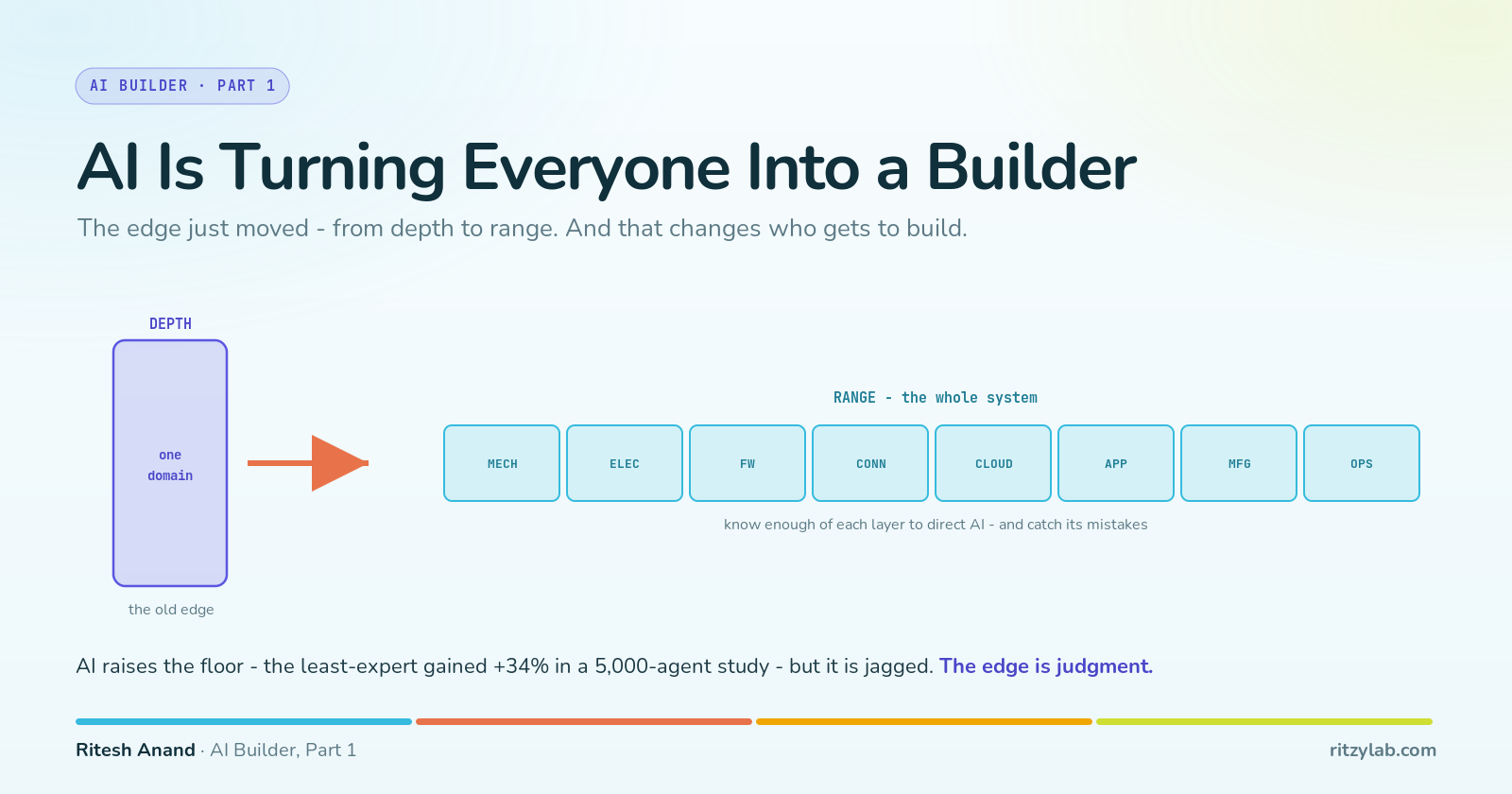
The clearest evidence isn't a demo, it's a field study. Economists Erik Brynjolfsson, Danielle Li, and Lindsey Raymond followed 5,179 customer-support agents as a generative-AI assistant rolled out. Productivity rose 14% on average - but the gain was 34% for the least-experienced and lowest-skilled agents, and close to zero for the top performers. The AI worked by spreading the habits of the best workers to everyone else.
That is the pattern that matters. AI lifts the floor far more than the ceiling. It hands a non-expert a near-expert first draft - of code, a schematic sketch, a test plan, a supplier comparison - in a domain they've never trained in. The cost of starting in a new layer has collapsed.
▸ First principle. AI lifts the least-expert the most - so access to a domain is no longer the moat it used to be.
2. But access isn't judgment
Here is the catch, and it is the whole game. In a separate study of 758 Boston Consulting Group consultants, Fabrizio Dell'Acqua, Ethan Mollick, and colleagues found something they named the "jagged frontier." On tasks inside AI's capability, consultants using GPT-4 did 12% more work, 25% faster, at ~40% higher quality. On tasks just outside that frontier, the same AI made their answers worse - confidently, invisibly worse.
That is the trap of a raised floor: AI is brilliant inside its frontier and wrong just outside it, and it will not tell you which side of the line you're on. It won't warn you that a mechanical tolerance breaks the design, that a supplier's datasheet is optimistic, or that a control loop is unsafe. So the real question shifts from "can AI build this?" to "do I understand the system well enough to direct it - and to catch it when it's quietly wrong?"
▸ First principle. A tool creates leverage only when the human can direct it - and verify it.
3. The edge moved: from depth to range
Put those two facts together and the conclusion is uncomfortable for a decade of career advice. If AI can go expert-deep in any single domain on demand, then depth in one domain is no longer the rare, defensible thing. What becomes scarce is the opposite: range - enough awareness across the whole system to know which domain's logic applies, to hand AI the right context, and to sanity-check what it returns.
This isn't the shallow generalist of the old joke. It's a builder who knows enough of every layer to ask the right question and spot the missing constraint - and who reaches for a true specialist exactly when the stakes demand it. The broadly-aware builder was underrated for years. In the age of AI, that awareness is the multiplier.
▸ First principle. Range now beats depth - because breadth is the one thing AI can't supply for you.
4. What AI still can't do for you - yet
It's worth being precise here, because the honest version is more useful than the hype. Today's AI can raise the floor in each layer, but it cannot yet stitch the layers together on its own. On long, multi-step tasks that cross tools and domains, current agents still succeed only a fraction of the time - industry benchmarks in 2026 put sustained, cross-application task completion in the rough range of one-in-five to one-in-four. Andrew Ng calls persistent memory - an agent that actually accumulates and connects what it learns - the key advance still "coming soon," not something today's tools reliably have.
So for now, you are the integration layer. You hold the whole picture; AI does the depth inside each box. That may shift as agent memory matures - but even then, someone has to define the product, supply the context, and own the judgment.
▸ First principle. Until agents can span the whole system, the human who can is the one who ships.
5. So: become an AI Builder
That is what this series is for. An "AI Builder" is not someone who has mastered every domain - no one has. It's someone with enough awareness across the whole stack to give AI strong context, verify its output, talk to specialists, and move an idea toward a real, shippable product. Building it is one half; running it is the other. Both are now within reach of a small, broadly-aware team.
Over the coming weeks, AI Builder walks that stack one layer at a time - the build side: mechanical, electronics, firmware, connectivity, cloud, the app, and manufacturing; then the run side: audience, marketing, sales, support, and unit economics. For each, the same three questions: what is the minimum you need to know, what does AI now do for you, and where can expertise still not be faked.
▸ First principle. The new full-stack isn't software - it's the whole product, and awareness across it is the skill.
Try this today. Point your AI at whatever you're building and give it the whole-system prompt below. The gaps in its answer are your personal study map - the layers you're handing off without realizing it.
You are a senior product engineer. I'm building: [describe your product].

Map it across every layer of a connected product - mechanical, electronics,
firmware, connectivity, cloud, app, and manufacturing - then the business side:
audience, marketing, sales, support, and unit economics.

For each layer, give me:
1. the 2-3 decisions that matter most,
2. the most common mistake teams make,
3. one question I should be able to answer before I build it,
4. where I will still need a real expert.

Be specific to my product, not generic.
The point of the series is to make that map yours - so you can read AI's answer, catch what's off, and build with judgment instead of hope.
FAQ
What does "AI Builder" mean?
An AI Builder is a person who uses AI to work across the full stack of a product - idea, design, electronics, firmware, cloud, app, manufacturing, and the business around it. It's not about mastering every domain; it's about having enough awareness of each to give AI strong context, verify its output, and move the product forward.
Does AI really help beginners more than experts?
The evidence points that way. In a field study of 5,179 support agents, a generative-AI assistant raised productivity 34% for the least-experienced workers and close to zero for the most experienced - it spreads the best workers' practices to everyone else, raising the floor more than the ceiling.
Will AI replace engineers and specialists?
Not the judgment. AI is powerful inside its "jagged frontier" and confidently wrong just outside it, and on long multi-step tasks across domains it still fails most of the time. Someone has to direct it, catch its mistakes, and integrate the whole system - which is exactly where deep specialists and broadly-aware builders both stay essential.
What is the "jagged frontier"?
A term from a Harvard/BCG study of 758 consultants: AI's capability is uneven. Inside the frontier it lifts quality sharply; just outside it, it can make work worse - while giving no signal about which side of the line a given task falls on. Knowing the frontier is a human skill.
What skills matter most for building in the age of AI?
Breadth and judgment. Enough awareness across every layer of a product to ask the right questions, supply AI the right context, verify what it returns, and know when to bring in a specialist - the "range" that AI cannot supply for you.
The short version of this is on my LinkedIn. Next in AI Builder, Part 2: the map no one handed you - the two stacks behind every connected product. The longer story and the links live on my profile.
Sources: Brynjolfsson, Li & Raymond, "Generative AI at Work" (NBER/QJE); Dell'Acqua, Mollick et al., "Navigating the Jagged Technological Frontier" (Harvard Business School / BCG); 2026 agent-reliability benchmarks; Andrew Ng on agentic memory.
Stay in the loop
New essays on embedded systems, firmware quality, and engineering craft. No noise.
Discussion
No comments yet. Be the first to share your thoughts.
Leave a comment