What this is. Opinion + Experience + Fact (15% opinion · 15% experience · 70% fact). Written in collaboration with AI — I discuss, I do not outsource.
On August 3, 2026, T-Mobile retired the last 2G network in the United States. The devices it carried didn't fail — their assumption did. What the American 2G sunset teaches every team building a connected product, and how to design for the day your network retires.
On August 3, 2026, America's last 2G network went quiet. No outage, no failure — a scheduled goodbye. And overnight, thousands of perfectly working devices — meters, trackers, alarms — kept doing their jobs flawlessly, with no one left to listen.
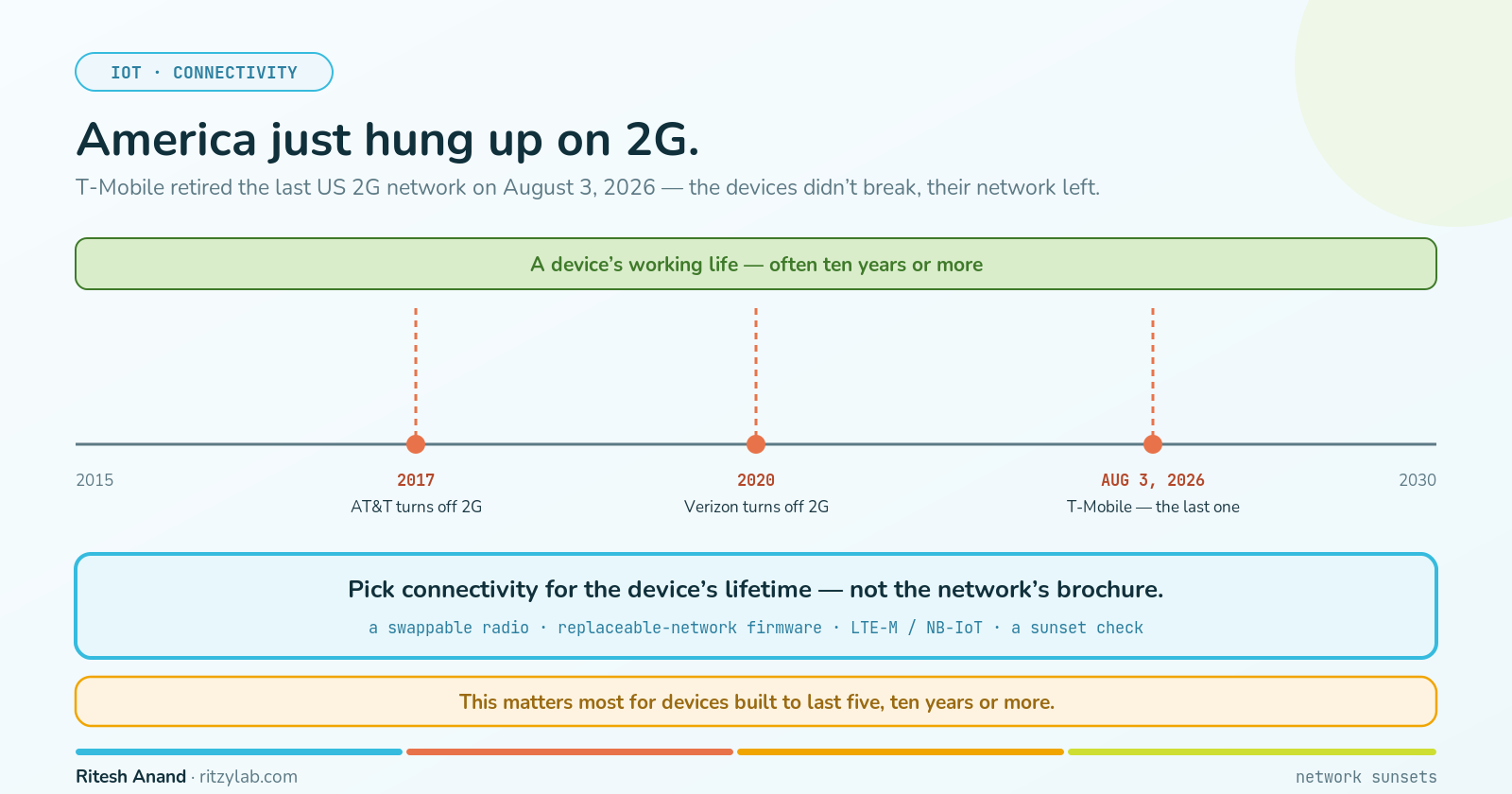
T-Mobile was the final holdout: AT&T closed its 2G network in 2017, Verizon in 2020. With this August's shutdown, the era that quietly carried the first generation of connected products in the US is over. That makes this a good week to talk about what those stranded devices actually teach us — because the lesson is not about 2G at all.
1. The network that carried the first IoT wave
Before "IoT" was a word, 2G was already running it. Smart meters reporting consumption over GPRS. GPS trackers on trucks and containers. Home alarms phoning the monitoring center. Vending machines ordering their own refills. The first machine-to-machine wave was built almost entirely on 2G — and for good reasons.
The modules were cheap. The coverage was everywhere. The data needs were tiny — a meter reading is a few bytes, and 2G carried a few bytes beautifully. Careful teams doing careful work picked 2G because it was the rational choice, and for years it was exactly right.
What none of those spec sheets mentioned was a retirement date — because at design time, nobody knew one. The network felt like infrastructure: permanent, like roads. It wasn't. It was a service, run by companies with their own spectrum economics, and spectrum is worth more carrying 5G than carrying meter readings.
▸ First principle. Infrastructure you don't own has a lifetime you don't control.
2. Stranded is not broken
Here is the uncomfortable part: the stranded devices are not failures. The hardware is fine. The firmware is fine. Many were engineered to last a decade or more, and they will happily run for another one — with nobody to talk to.
What failed was an assumption baked in at design time: that the network would outlive the device. Home alarms, medical alert units, fleet trackers — products whose service life was longer than the remaining life of the network they shipped on. Nothing in the device can fix that, because nothing in the device is wrong.
▸ First principle. A connected product lives only as long as the youngest of its dependencies.
3. The cycle is already restarting
It would be comforting to treat this as a one-time cleanup of old technology. It is not. The same economics that retired 2G are already at work one generation up: carriers are re-farming 4G spectrum toward 5G, and activation rules for LTE-only devices are beginning to tighten. Every G eventually gives its spectrum to the next one.
And the calendar is not global — it is per country. While the US has now closed 2G entirely, India and much of Africa still run large, active 2G networks with no announced end date, and plenty of low-cost devices ship on them today. A fleet that spans markets has several sunset clocks running at once, each on its own schedule.
One more honest observation from the American experience: the teams caught off guard were not careless. Sunsets were announced years ahead — but the notices traveled by email to people who changed roles, left companies, or were lost in acquisitions. The message existed; the path to the product team didn't.
▸ First principle. Every G retires — the sunset calendar of every country you ship to is part of your product, not a footnote.
4. Designing for the network's retirement
First, the honest scoping — because this is not a reason to panic-redesign everything. Networks retire over years, with public notice, not overnight. The question is a simple ratio: your device's target service life versus the network's upgrade cycle. A product meant to live two or three years can reasonably ride the mainstream network of the day and never meet a sunset. A meter, an industrial sensor, a medical device — anything meant to serve five, ten years or more — will very likely cross at least one network transition in its lifetime, and that is the product this chapter is for. If you are designing on 4G today while 5G takes over the spectrum plans, this is exactly the calculation to run.
Second, the cost honesty: designing for migration is not free. Long-support network tracks, a modular radio, the engineering time for a clean connectivity layer — each adds cost up front. That cost has to be weighed against what a stranded fleet costs at the other end: replacing or retrofitting every unit in the field, unit by unit. For a long-life device, that trade almost always favors paying early — but it is a trade, and it belongs in the BOM discussion, not discovered after launch.
With the scope and the cost on the table, four design decisions, all cheapest at the start:
Treat the network as replaceable in firmware. If your application code talks to "the connectivity layer" rather than to one modem's quirks, swapping radios is an engineering task, not a rewrite.
Make the radio swappable in hardware where the product's life justifies it. A socketed or modular connectivity design costs a little more per unit and saves the fleet when the network moves on.
Pick the long-life tracks for long-life devices. LTE-M and NB-IoT exist precisely for devices that outlive phones — designed for low data, low power, and long support horizons.
Put the sunset check in the product's calendar, not a person's inbox. A recurring review of the network roadmap in every market you ship to — owned by the product, surviving every reorganization. That is the process fix for the failure mode America just demonstrated.
▸ First principle. Design for the network's retirement on the day you pick the network.
The devices stranded this August were built by good teams who made the right call with the information in front of them. The information has changed: we now know, from three sunsets in one product generation, that the network is a dependency with its own clock. Pick connectivity for the device's lifetime — not the network's brochure — and the next sunset becomes a migration you planned, not a fleet you mourn.
Sources
T-Mobile's 2G GSM retirement on August 3, 2026 per TechTimes and PhoneArena; AT&T's 2017 and Verizon's 2020 2G closures and the 3G phase-out per the FCC consumer guide and emnify's global 2G/3G phase-out timeline (also the source for per-country status, including active 2G in India and Africa). LTE re-farming toward 5G and tightening LTE-only activation rules per tmo.report. The communication-failure lesson (notices lost to role changes and acquisitions) per IOT Insider. No fleet counts or percentages are claimed in this piece.
FAQ
When did 2G shut down in the United States?
In stages: AT&T closed its 2G network in 2017, Verizon in 2020, and T-Mobile — the last US carrier still running 2G — retired its network on August 3, 2026. With that closure, there is no remaining 2G service from a major US carrier.
Why did so many IoT devices use 2G?
Because it was the rational choice when they were designed: 2G modules were inexpensive, coverage was nearly universal, and machine-to-machine data needs were tiny — a meter reading or an alarm signal is only a few bytes. The first generation of smart meters, GPS trackers, and connected alarms was built almost entirely on 2G.
What happens to devices stranded by a network sunset?
The devices keep working — hardware and firmware are unaffected — but they lose connectivity permanently. Unless the device was designed with a replaceable radio or an alternative network path, restoring service means physically replacing or retrofitting each unit in the field.
What should long-life IoT devices use instead of 2G?
LTE-M and NB-IoT are the cellular tracks designed for long-life, low-data devices, with long support horizons. For devices shipping across countries, the network roadmap of each market matters: 2G remains active in India and much of Africa with no announced end date, while the US and most of Europe have closed or scheduled closures.
Does every IoT device need to design for network sunsets?
No. The deciding ratio is the device's target service life versus the network's upgrade cycle. A product meant to live two or three years can reasonably use the mainstream network of the day. Devices targeting five, ten years or more — meters, industrial sensors, medical devices — will likely cross a network transition and should design for it, weighing the up-front cost of a migration-ready design against the field cost of a stranded fleet.
How do you design a connected product for network sunsets?
Four decisions at design time: abstract the network behind a connectivity layer in firmware so the radio can change without a rewrite; make the radio modular where the product's lifespan justifies it; choose long-support network tracks (LTE-M, NB-IoT) for long-life devices; and put a recurring network-sunset review into the product's own calendar so the check survives staff and ownership changes.
The short version of this is on my LinkedIn. The longer story — and how I think about building devices that outlive their networks — lives on my profile.
Stay in the loop
New essays on embedded systems, firmware quality, and engineering craft. No noise.
Discussion
No comments yet. Be the first to share your thoughts.
Leave a comment