What this is. Opinion + Experience + Fact (45% opinion · 10% experience · 45% fact). Written in collaboration with AI — I discuss, I do not outsource.
This year Arm shipped its first in-house silicon — a historic first for a company that spent three decades licensing designs rather than building chips. And it is the perfect moment to say the quiet part out loud: Arm's dominance was never about any single core. It was the ecosystem above it. Here is why that distinction matters, and what it means for anyone building a product on top of silicon.
In its Q2 FY2026 results Arm reported about $1.1 billion in quarterly revenue, up 34% year over year, and announced its move into building its own silicon for the first time in the company's history. It is a genuine milestone. It is also a useful moment to ask a question the headlines skip: why is Arm everywhere in the first place?
The intuitive answer is "great CPU cores." It is also the wrong one. Plenty of companies have designed fast cores. What none of them assembled is the thing that actually makes Arm hard to displace — the ecosystem that grew around the architecture over thirty years. Let me walk through what that ecosystem is, why it is the real moat, and the lesson it holds for every product built on a chip.
1. The core is licensable; the ecosystem isn't
Arm's business is licensing. Its cores are, by design, available to anyone willing to pay — which is why direct competitors like Qualcomm, Samsung, and MediaTek all ship Arm-based silicon and compete fiercely on top of the same designs. If the core itself were the moat, that would be a strange way to run a business.
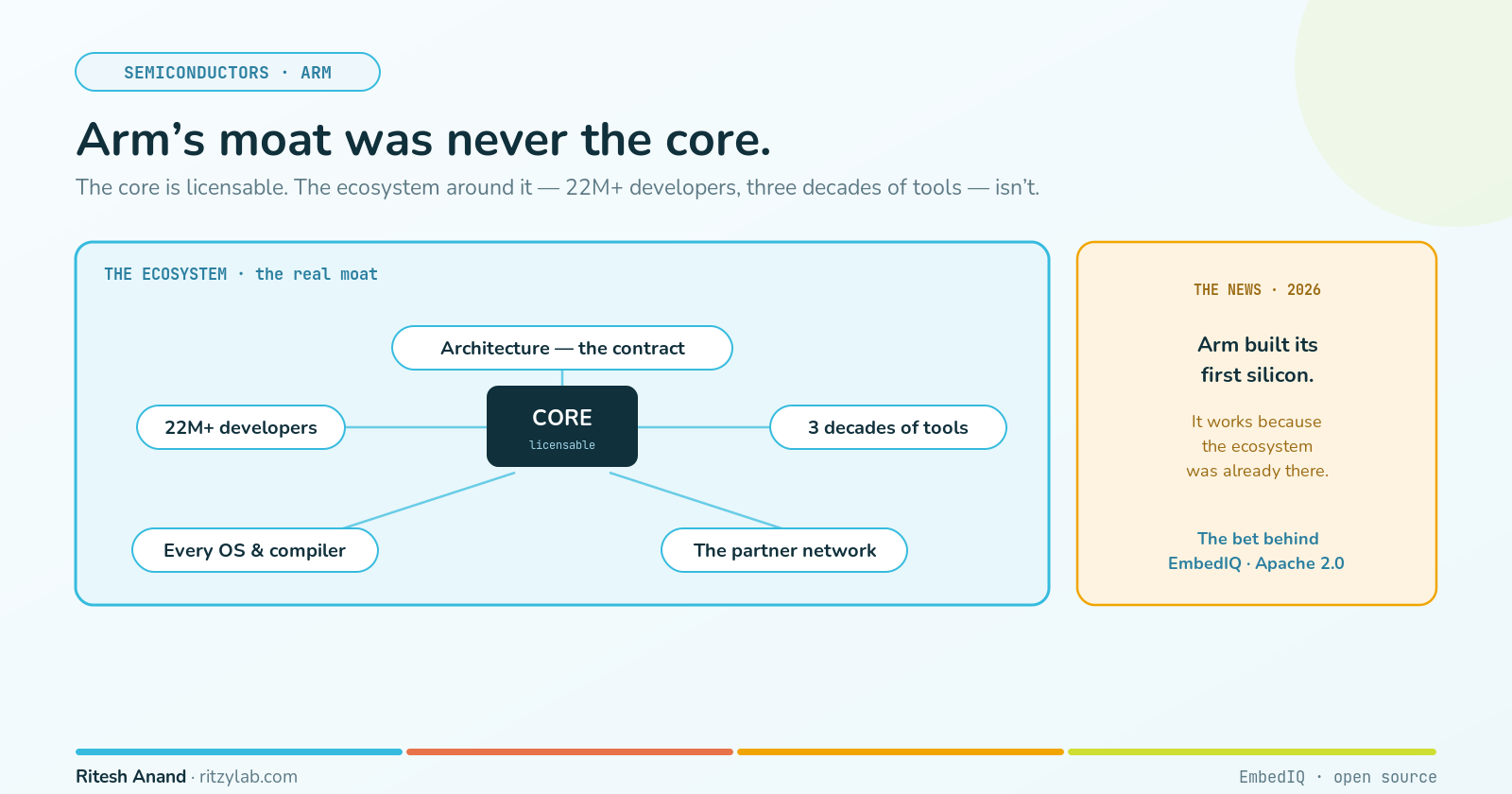
The moat is everything the core sits inside. More than 22 million software developers write code for the Arm architecture. Three decades of compilers, debuggers, operating systems, and libraries assume it. Every major OS boots on it. That surrounding mass is not something a rival can license or clone; it was grown, one project at a time, over a period longer than many engineers' entire careers.
▸ First principle. A core can be licensed or cloned; an ecosystem grown over decades cannot.
2. The architecture is the contract that makes it compound
Underneath the developer numbers is the thing that makes them possible: a stable contract. The Arm architecture — the instruction set and the rules around it — is a promise that a piece of software written today will keep running on chips built years from now. That promise is what lets an enormous ecosystem coordinate without a central planner.
Stability is what turns effort into compounding value. Because the contract holds, a compiler improvement helps every chip, a driver written once is reused for a decade, and a partner's investment is not wiped out by the next silicon generation. The hardware underneath can change every year; the contract above it does not, so the work stacks up instead of resetting. Even the competition among licensees feeds it — whichever of them wins a given socket, they all build against the same architecture, and Arm's ecosystem gets denser either way.
▸ First principle. The durable layer is the stable contract above the silicon, not the silicon itself.
3. Even the move into silicon rides the ecosystem
Here is the part that makes the point undeniable. Arm is now building its own chips — and it can only do that because the ecosystem was already there. A new piece of silicon from a company with no software, no developers, and no toolchain is an expensive paperweight. Arm's chip arrives into a world where 22 million developers and every major OS are already fluent in its language.
So the direction of causation matters. The ecosystem did not grow because Arm made a great chip; the chip became possible because Arm owned the ecosystem. That is the general shape of durable positions in this industry: you earn the right to move down into the core by first owning the layer above it. Do it the other way around — a great core with nothing around it — and you have a demo, not a moat.
▸ First principle. Own the layer above the core, and the core becomes an option you earn — not the other way around.
4. The same shape shows up all the way down
This is not only a story about a company of Arm's scale. The same pattern repeats at every scale of building on silicon, right down to a single embedded product. Underneath your application sits a chip you chose, and it is more swappable than it feels — a supply shock, a cost target, or an end-of-life notice can force a change of MCU, and often does. The RTOS beneath it is swappable too.
What you do not want to be swappable is your product. So the durable value has to live where Arm's lives: in the layer above the core — the architecture of your system and the shared foundation your team builds on. If that layer is explicit and portable, a chip change is a swap. If it is fused to one part number, a chip change is a rewrite.
▸ First principle. At every scale, the value that lasts is the architecture above the chip — because the chip is the part most likely to change.
5. The bet behind EmbedIQ
This principle is exactly why I built EmbedIQ the way I did. It is an open, RTOS-agnostic architecture layer that sits above the core — the Functional-Block structure, zero-instrumentation observability, configuration, telemetry, and an update-ready design — so the part that carries a product forward is not welded to any one chip or RTOS. It is not an attempt to be Arm; it is the same idea applied at the embedded-product layer: put the durability in the ecosystem-shaped layer above the silicon, and make it a shared foundation rather than a private rebuild.
I open-sourced it under Apache 2.0 for the reason Arm's history illustrates: a layer becomes durable when others can build on it freely. The value of a foundation is not in owning it — it is in how many products can stand on it. That is a long game, and it is the right one.
▸ First principle. A foundation compounds when it is open and shared — its worth is measured by what can be built on it, not by who owns it.
Arm building its own chip is a headline. The reason it can is the real story: three decades of ecosystem, sitting above a core that was always, by design, licensable. The lesson holds whether you are a trillion-dollar architecture or a team shipping one connected device — put your durability in the layer above the silicon, keep it explicit, and let it compound.
Sources
Arm Q2 FY2026 results — approximately $1.1B quarterly revenue, up ~34% year over year (Arm investor materials; Futurum, "Arm Q2 FY2026 Earnings"). Arm's move into building its own silicon for the first time — the Arm AGI CPU, announced 2026 (Arm Newsroom, "Arm expands compute platform to silicon products in historic company first"; Omdia analysis). Ecosystem scale — more than 22 million Arm developers and a three-decade software ecosystem, described as the core of Arm's moat and network effect (industry moat analyses). Competitive licensees (Qualcomm, Samsung, MediaTek) and the "co-opetition" model. EmbedIQ is the open-source, Apache 2.0, RTOS-agnostic architecture layer described here; the code and links live on my profile.
FAQ
What is Arm's real competitive moat?
It is the ecosystem around the architecture, not any individual CPU core. Arm licenses its cores to competitors like Qualcomm, Samsung, and MediaTek, so the cores themselves are not the defensible asset. The moat is the more than 22 million developers, the three decades of tools and operating systems, and the network effect that grew around the Arm instruction set — none of which a rival can license or clone.
Why does the ecosystem matter more than the CPU core?
Because the core is licensable and replaceable, while the ecosystem is not. Hardware makers choose Arm because a vast library of software already runs on it, and developers target Arm because it reaches the most devices — a self-reinforcing loop. That two-sided network effect, plus high switching costs, is what makes Arm hard to displace, independent of any single chip's performance.
What does it mean that the Arm architecture is a "contract"?
The architecture — the instruction set and its rules — is a stable promise that software written today will keep running on future chips. That stability lets thousands of chips and millions of programs coordinate without resetting each generation, so tools, drivers, and partner investments compound over time instead of being rewritten.
Does Arm building its own chips change the ecosystem argument?
No — it confirms it. Arm can move into building silicon precisely because the developers, tools, and architecture were already in place; a chip with no ecosystem around it has little value. The ecosystem made the chip possible, not the other way around, which is the whole point: you earn the right to own the core by first owning the layer above it.
What is the lesson for someone building a single embedded product?
Put your durable value in the layer above the chip. The MCU and the RTOS are more swappable than they feel — cost, supply, or end-of-life can force a change. If your product's architecture is explicit and portable, a chip change is a swap; if it is fused to one part, it is a rewrite. EmbedIQ is an open, RTOS-agnostic version of that layer, applying Arm's lesson at the embedded-product scale.
The short version of this is on my LinkedIn. The architecture layer is open source — it's called EmbedIQ, Apache 2.0 — and the code and the links live on my profile.
Stay in the loop
New essays on embedded systems, firmware quality, and engineering craft. No noise.
Discussion
No comments yet. Be the first to share your thoughts.
Leave a comment