What this is. Opinion + Experience + Fact (30% opinion · 50% experience · 20% fact). Written in collaboration with AI — I discuss, I do not outsource.
A discontinued part is not a purchasing problem. It is a clock that starts the day the notice lands — and it touches engineering, compliance, and the factory floor all at once. Here is how to survive one, and how to stop the next from ambushing you.
The email looks routine. A product change notification from a supplier you have used for years. You almost archive it. Then you read the three letters that reorganize your quarter: EOL. End of life. The chip on your board — the one already soldered onto ten thousand units in production — is being discontinued.
Every hardware team meets this moment eventually. We have walked a lot of teams through it, and the ones who come out clean are never the ones with the best luck. They are the ones who treated their bill of materials as a living thing long before the notice arrived.
1. The notice that quietly stops your week
An end-of-life notice usually comes with one mercy: a last-time-buy date. Place your final order by then, and the part keeps flowing until your stock runs out. That sounds like breathing room. It is actually a fork, and both paths cost you.
Buy big, and you tie up cash in inventory you are betting you will use before it ages out — and you have only deferred the problem. Buy small and redesign, and you have signed up to swap a component in a product that is actively shipping, without stopping the line. There is no third door where nothing changes. The notice already changed it.
▸ First principle. An EOL notice is not a parts problem — it is a clock. The day it arrives, you are already behind.
2. Why it is never just one part
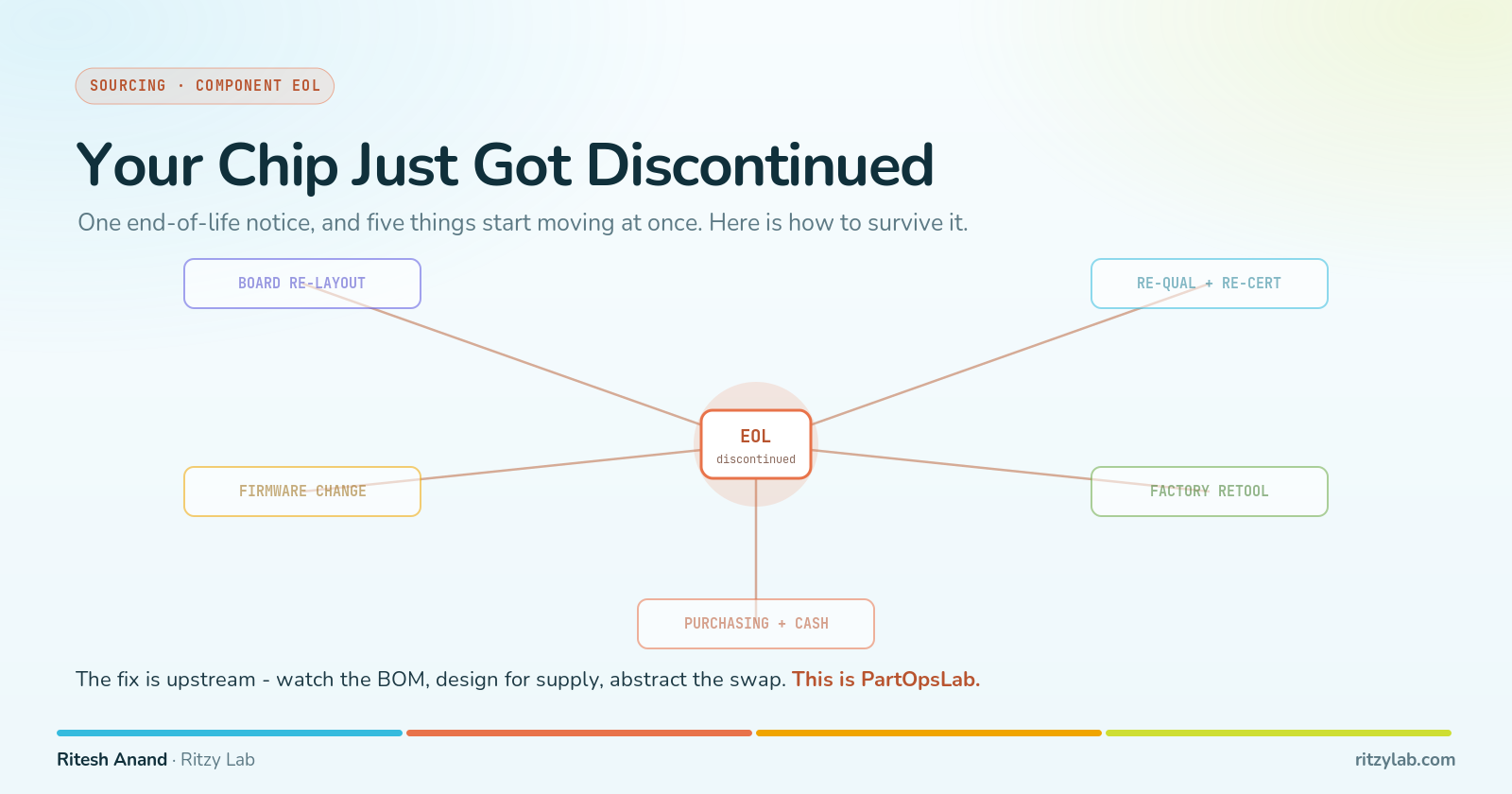
The trap is thinking a discontinued component is a swap. It rarely is. Pull one part and the change ripples outward: a new footprint means a board re-layout; a different chip means re-qualification and often re-certification for EMC or safety; new timing or registers mean a firmware change; and the factory needs new test fixtures, line setup, and documentation. Purchasing, engineering, compliance, and operations all get pulled in — usually before anyone has agreed who owns the fix.
That is the real cost of an EOL: not the price of the new part, but the coordinated scramble across four functions that were not planning to talk this week.
▸ First principle. One discontinued part touches engineering, purchasing, compliance, and the factory floor at the same time.
3. The real fix is upstream — before the notice ever arrives
Here is the shift that separates the teams that panic from the teams that shrug. They stopped treating the bill of materials as a static list you finish and file, and started treating it as a living risk surface you watch. Concretely, that means three habits. Monitor lifecycle status on every part, so an EOL is a twelve-month heads-up instead of a fire drill. Design for supply from the start — second sources qualified in, not discovered in a crisis. And build in abstraction, so that swapping a chip is a contained change, not a redesign — when the firmware talks to hardware through a clean driver boundary, a replacement part becomes a driver update, not a rewrite of the whole application.
None of that is glamorous. It is the quiet product-ops discipline that keeps a shipping product shipping — and it is exactly the work most teams skip until an EOL notice teaches them why it mattered.
▸ First principle. The cheapest EOL migration is the one you designed for before the notice arrived.
4. When it hits anyway — you stage it, you never flip the line
Sometimes the notice lands before the discipline does. When it does, the migration is a managed project, not a heroic weekend. You do the last-time-buy math honestly — enough stock to cover the redesign runway, not a decade of dead inventory. You find the closest drop-in alternate you can, to shrink the change. You run re-qualification and any re-certification in parallel with the redesign, not after it. And you cut the new part into the line in stages, on a controlled build, watching yield before you commit the whole product — for the same reason you never push firmware to an entire fleet at once.
▸ First principle. When you cannot avoid the migration, you stage it — you never flip the whole line in one step.
This is the work we do
Component obsolescence, second-sourcing, the BOM that quietly turns into a liability after you thought you were done — this is the part of building hardware that never makes the demo, and it is exactly what we built PartOpsLab for — our part-sourcing and BOM-resilience practice at Ritzy Lab. We help teams turn their bill of materials into something they can trust: watched for lifecycle risk, designed for supply, and ready for the day a supplier changes its mind.
If there is an EOL notice sitting in your inbox right now — or a BOM you have never stress-tested — that is a conversation worth having before it becomes a fire. Reach out, or send me a DM, and let's talk it through.
FAQ
What does it mean when a component goes EOL (end of life)?
The manufacturer is discontinuing it. You will usually get a product change or end-of-life notification with a last-time-buy date — the deadline to place a final order — after which the part is no longer produced and you must either live on remaining stock or move to a replacement.
What is a last-time-buy, and how much should you order?
It is your final purchase before production stops. Size it to cover the time you realistically need to design in and qualify a replacement, plus a safety margin — not years of speculative demand, which ties up cash and risks the parts aging out unused.
Why is replacing a discontinued component so expensive?
Because it is rarely a like-for-like swap. A new part can force a board re-layout, re-qualification, EMC or safety re-certification, a firmware change, and new factory test fixtures — a coordinated effort across engineering, purchasing, compliance, and operations, not a single line-item change.
How do you avoid EOL surprises?
Treat the BOM as a living risk surface: monitor every part's lifecycle status for early warning, design in qualified second sources from the start, and keep firmware talking to hardware through a clean driver boundary so a part swap stays a contained change instead of a redesign.
Should you redesign or place a large last-time-buy?
Usually both, in sequence: a measured last-time-buy to protect the shipping product and buy runway, while a planned redesign to a supply-safe alternate proceeds in parallel — then stage the new part into the line on a controlled build before committing the whole product.
The short version of this is on my LinkedIn. If component obsolescence is a live problem for your team, the fastest path is a direct conversation — reach out or DM me.
Stay in the loop
New essays on embedded systems, firmware quality, and engineering craft. No noise.
Discussion
No comments yet. Be the first to share your thoughts.
Leave a comment