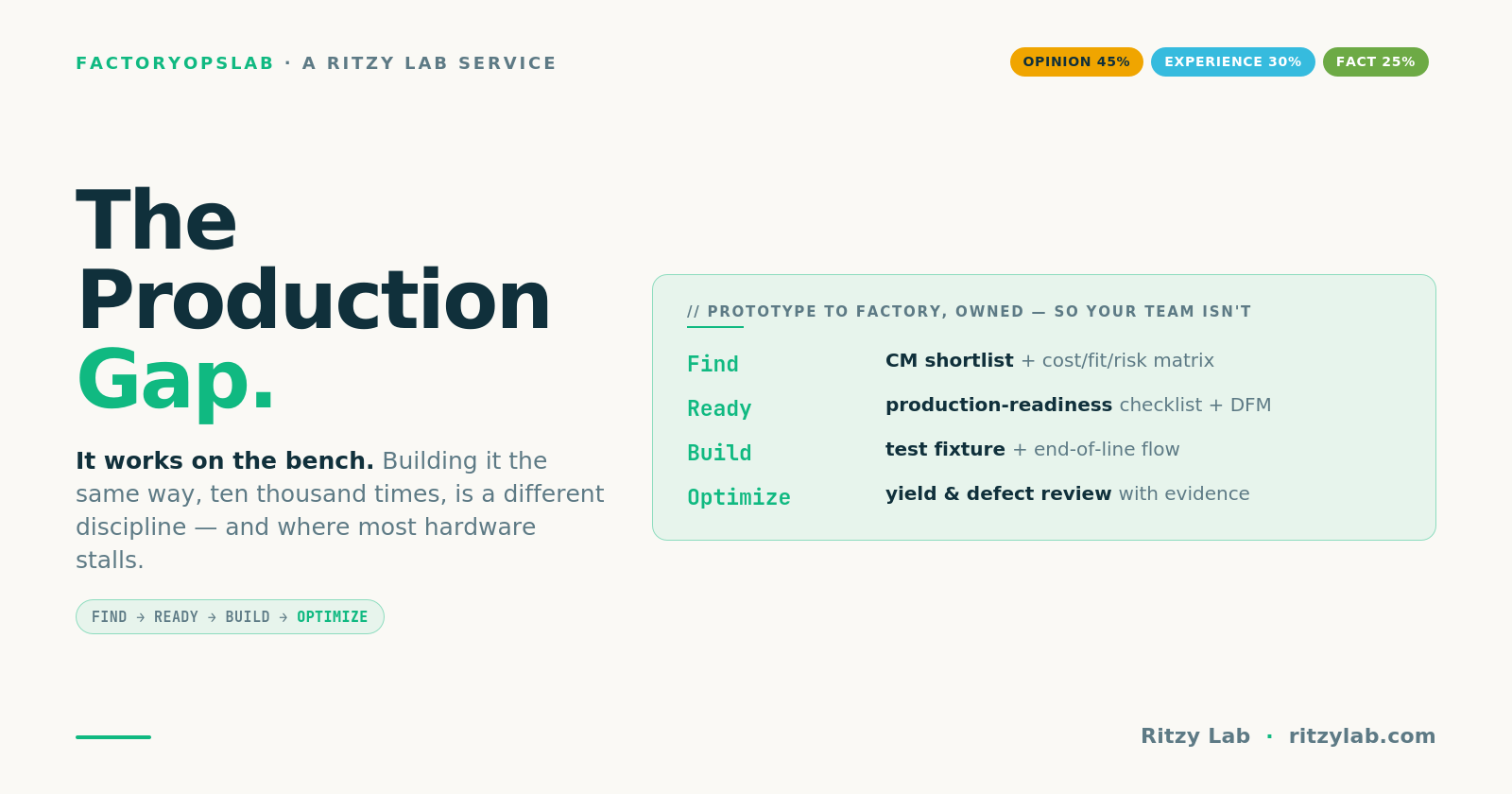
What this is. Opinion + Experience + Fact (45% opinion · 30% experience · 25% fact). Written in collaboration with AI — we discuss, we do not outsource.
From Ritzy Lab — introducing FactoryOpsLab, our engineer-led manufacturing-readiness, CM-search, fixture, and end-of-line-test service.
1. The gap where good hardware stalls
A working prototype is a milestone, and it is worth celebrating. It is also the most dangerous moment in a hardware program — because it feels like the hard part is over, and it is not. The gap between "it works on the bench" and "it ships from a factory, the same way, ten thousand times" is where a startling number of good products quietly stall.
The numbers are sobering: industry estimates put the share of hardware startups that never reach mass production at well over half — commonly cited around 70%. The cause is rarely the idea or even the prototype. It is everything between the prototype and the line: a manufacturer that has to be found and vetted, a design that has to survive being built by people who are not the inventor, a bill of materials that has to be sourced for real, a test fixture that does not exist yet, and an end-of-line process that decides whether each unit is good. None of that is glamorous. All of it is where the product lives or dies.
We see the same pattern again and again: the team is brilliant at the product and underwater on the transition, because the transition is a different discipline than the one that got them the prototype.
▸ First principle. A prototype proves the product can work. Production proves it can be built — repeatably, by other people, at scale. They are different problems, and the second one is where most hardware stalls.
2. Why prototype and production are different disciplines
A prototype optimizes for one thing: proving the idea, fast. Production optimizes for a completely different set of things: repeatability, availability, yield, compliance, and cost at scale. Almost every shortcut that made the prototype fast becomes a liability when you try to build a thousand of them.
The failure modes are well-worn. A part that was perfect for a few units turns out to have a 52-week lead time when production approaches — a real and common trap when a prototype BOM is built from convenient parts instead of verified, second-sourced ones. A through-hole, hand-soldered, jumper-wired board cannot be reproduced on a line without a real redesign for manufacturability. A supplier who always came through for sample runs cannot hold quality at volume. An assembly step a lead engineer does in thirty seconds takes a production operator three minutes, and now it is the bottleneck. Certification that was deferred forces a board redesign late, when it is most expensive. Each of these is survivable on its own. Hit several at once, with no plan, and the launch slips a quarter — or stops.
The deeper issue is that these problems surface late, all at once, exactly when the team has the least slack. By the time "production chaos" is urgent, the cheap moment to have addressed it has passed.
▸ First principle. The shortcuts that make a prototype fast are the exact things production punishes. The bill comes due late — and the team has the least room to pay it then.
3. The benefit: cross the gap without burning your engineers
Here is the reframe, and it is the same one that runs through everything Ritzy Lab does. Your core engineers are the scarcest resource you have. The prototype-to-factory transition is critical work — but very little of it is the core product work that only your team can do. Finding the right contract manufacturer, comparing quotes, running a production-readiness review, designing a test fixture, writing an end-of-line test flow: it is real engineering, but it does not have to be your engineers' engineering.
When that work is owned by someone whose job it is — someone who has crossed this gap before — two things happen. Your engineers stay on the product, where they compound value, instead of being pulled into factory logistics they will do once and never again. And the transition itself goes better, because it is being run by people who have seen how it fails and built the checklists that prevent it.
The earlier this starts, the cheaper it is. Production readiness addressed while there is still slack is a calm review. The same readiness addressed the week before a pilot build is a fire drill. Crossing the gap on purpose, early, with help, is far less expensive than crossing it by accident, late, alone.
▸ First principle. Most of the prototype-to-factory work is critical but not core. Hand it to someone who has crossed the gap before, and your engineers stay on the product while the transition goes better.
4. What FactoryOpsLab actually does
FactoryOpsLab is the engineer-led service that owns the crossing. You can enter at any stage — "find us a contract manufacturer," "help us compare these quotes," "tell us if we're production-ready," "we need a test fixture," "we need an end-of-line test plan," "our pilot build is coming" — and we take it from there. Four loops cover the path:
| Loop | What we do | What you get back |
|---|---|---|
| Find | CM shortlist, vendor questionnaire, capability comparison, cost/fit/risk matrix, interview prep | A manufacturer recommendation you can act on |
| Ready | Build-readiness checklist, DFM/DFT review coordination, BOM readiness, documentation-gap review, risk register, pilot-build plan | A clear production-readiness picture |
| Build | Fixture concept, test-station requirements, end-of-line test flow, test scripts and logs, operator checklist, pass/fail criteria | A test setup and evidence trail |
| Optimize | Pilot-build tracking, issue triage, yield and defect review, root-cause support, manufacturing handoff docs | A line that improves with evidence |
It is AI-assisted and human-reviewed: AI helps with research, BOM and documentation review, and first-pass checklists and test drafts; the manufacturing judgment, the vendor decisions, and the final recommendations stay with a person who has taken products to production before. We are not a contract manufacturer and we do not replace your team — we are the engineer-led readiness layer that gets the product to the line cleanly. Pricing is simple: a free triage call to decide where to even start — CM search, readiness, fixture, or end-of-line test — then you pick the loop and the delivery desk that fit. Start with the one thing that is most urgent. Expand only when it earns it.
▸ First principle. Cross the gap one loop at a time, run by someone who has crossed it before — find the maker, prove you're ready, build the test, improve the line.
So before the prototype's success becomes the next quarter's production scramble: which part of the path to the factory is going to land on your core engineers — and what would it free them to build if it didn't?
Start with a free triage call → cal.com/ritzy · factoryopslab.com
Labeled: Opinion + Experience + Fact (45% opinion · 30% experience · 25% fact)
Sources:
- Why hardware startups fail at scale — the prototype trap (sourcing, DFM, yield, the 52-week lead-time trap)
- The industrial scaling playbook — why most hardware startups fail
- Why prototypes fail at scale — production is a different discipline
(Written in collaboration with AI — we discuss, we do not outsource.)
— Ritzy Lab | ritzylab.com · FactoryOpsLab
#HardwareEngineering #Manufacturing #DFM #NPI #ProductDevelopment
Stay in the loop
New essays on embedded systems, firmware quality, and engineering craft. No noise.
Discussion
No comments yet. Be the first to share your thoughts.
Leave a comment