What this is. Opinion + Experience + Fact (40% opinion · 15% experience · 45% fact). Written in collaboration with AI — I discuss, I do not outsource.
An RTOS now maintains its own security — CVE tracking, backports, a public vulnerability posture. But proving your product's security, across a fleet, over a decade, lives in the architecture above the kernel. Here is why that layer is becoming the real moat, and what it takes to build it.
Two quiet signals landed this week. Zephyr's vulnerability tracking kept ticking with fresh maintenance, and the agenda for its August community meetup read like a production checklist — crypto-suite migration, coredump capture over the network, storage stacks, timekeeping correctness. Neither is a headline. Together they mark a shift that matters: an RTOS is becoming a maintained security platform, not just a scheduler and a kernel.
That is good news, and it raises the bar for everyone shipping connected products. Because once the RTOS layer maintains its own security, the question for your product moves up a level — to the architecture above the kernel, where the evidence of security actually has to be produced. Let me walk through the shift, why it is really an architecture question, and the concrete capabilities it now demands.
1. The RTOS is maturing into a security platform
For years, choosing an RTOS was a features-and-footprint decision: tick rate, memory, driver support, licensing. That is changing. A modern open-source RTOS like Zephyr now ships with active CVE tracking, a disclosure process, and backport discipline across supported releases — the machinery of a maintained security platform, not just a kernel you compile in.
The counter-intuitive part is that this transparency is an advantage. A public vulnerability posture — knowing what was found, fixed, and backported — is exactly what a regulated, long-lived product needs from its foundation. Security transparency is becoming an adoption accelerant, not a liability.
▸ First principle. A maintained security posture is becoming part of the RTOS baseline — an expectation, not a bonus.
2. Where the RTOS stops: the architecture above the kernel
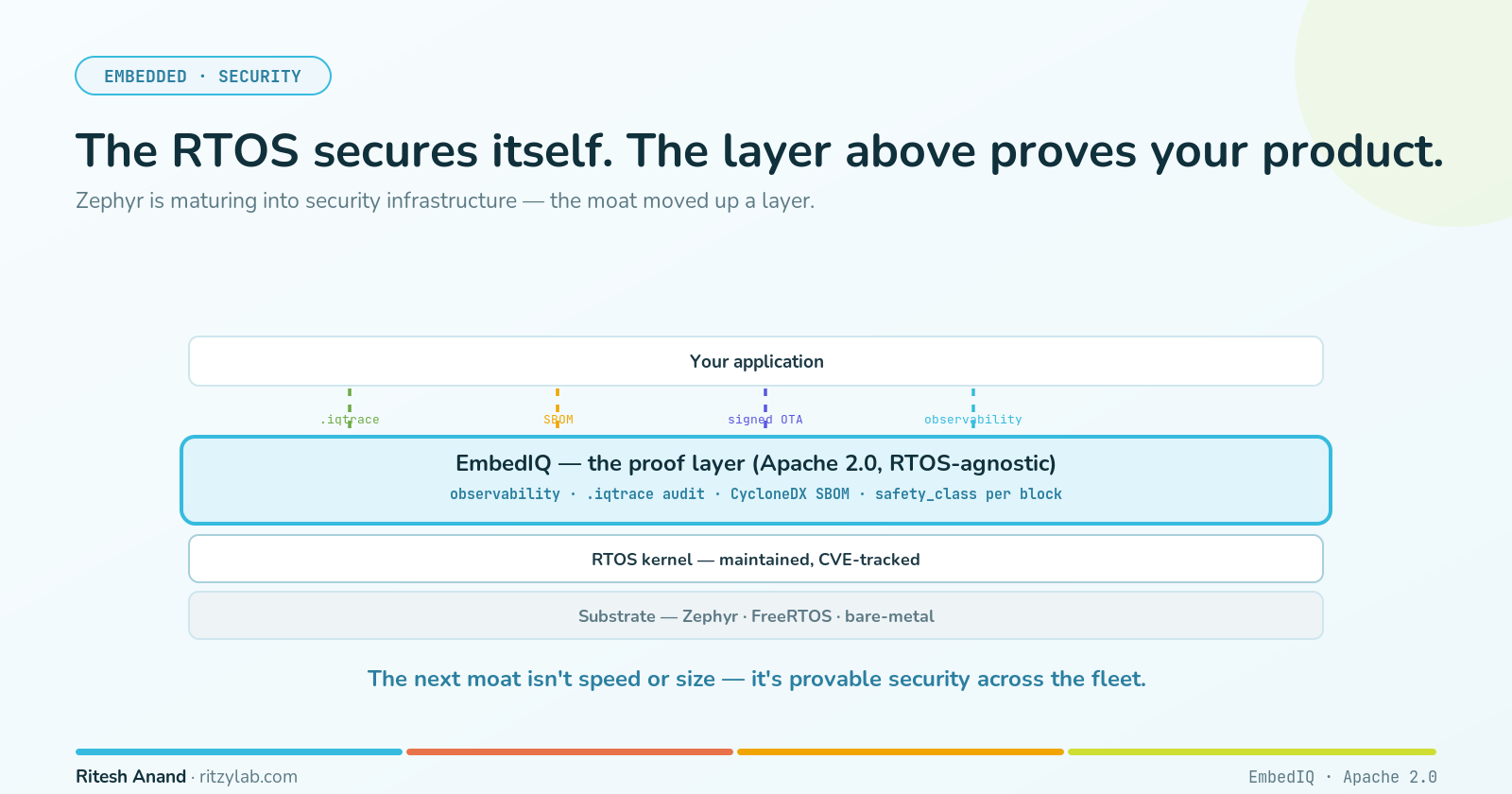
An RTOS secures and maintains itself. It does not, by design, define how your product proves its own security. Signed firmware updates, a software bill of materials, a tamper-evident audit trail, secure provisioning, per-device identity, fleet telemetry — these live above the kernel, in the application architecture the RTOS deliberately leaves to each team.
You can read the same message in Zephyr's own meetup agenda. Coredump-over-network, storage, timekeeping, crypto migration — these are the field-facing subsystems, the parts that decide whether you can see, patch, and account for a device once it is in someone's hands. That is where the real work sits, and it is not the kernel's job.
▸ First principle. The RTOS secures itself; proving your product's security is the layer above it.
3. The CRA turns security from a claim into continuous proof
Regulation is what forces the point. The EU Cyber Resilience Act makes cybersecurity a condition of selling a connected product in Europe — with a machine-readable SBOM, a real vulnerability-handling process, a signed update path, and incident reporting, on a timeline that has already begun. It moves the question from "are we secure?" to something sharper: "can we prove, patch, and explain our security across a ten-year fleet?"
That is not a documentation task you finish the week before an audit. A truthful SBOM has to be generated from how you actually build. You cannot report a vulnerability a device never recorded, or push a fix to a device with no safe update path. Continuous proof is an architecture capability — it either falls out of how the system is built, or it does not exist.
▸ First principle. Compliance is cheapest as a by-product of the architecture, and most expensive as a retrofit.
4. The proof layer, concretely — and why we open-sourced it
This is the layer we built, and open-sourced under Apache 2.0. EmbedIQ is an RTOS-agnostic architecture layer — the same application code runs above Zephyr, FreeRTOS, POSIX/Linux, or bare-metal. It exists because we spent 25 years watching teams rebuild the same infrastructure above the kernel on every project, and decided to solve it structurally instead.
The proof capabilities are built into the architecture, not bolted on afterward. Observability is zero-instrumentation — every event is captured automatically as the system runs, and the Observatory produces a tamper-evident .iqtrace audit trail with no developer wiring. A CycloneDX SBOM comes out of the build, open-source components included. Every Functional Block carries a safety_class field, mapping to standards like ISO 26262, IEC 62304, and IEC 62443. And because the whole thing runs on your laptop first — same code, host and device — you can watch the system, and its evidence, before any hardware exists.
Let me be precise about the boundary, because it matters: EmbedIQ does not make you compliant, and no framework can — certifying your product is your responsibility. What it does is put the evidence the CRA asks for on your side of the line by default, so you begin most of the way there instead of scrambling backward from a design that never produced it. We did not build this to chase a trend; it came from two decades of building embedded products, and this week's Zephyr and CRA signals point the same way. The framework is public, Apache 2.0, and runs on Linux today.
▸ First principle. Evidence you can trust is produced by the architecture as it runs — not assembled for the auditor at the end.
5. What to build now
You do not need to solve 2027 this quarter. You need to start the capabilities everything else hangs off — and decide, deliberately, whether they live in your architecture or get retrofitted later.
| Capability | What "designed in" looks like | Why the RTOS won't do it for you |
|---|---|---|
| Observability | Every event captured automatically, human- and machine-readable | The kernel schedules; it does not narrate your application |
| SBOM | CycloneDX generated from the real build, open source included | Lives at the application/build layer, not the kernel |
| Safe updates | Signed, verifiable, staged, reversible OTA across the fleet | Update policy is a product decision, above the RTOS |
| Audit trail | Tamper-evident record of what the device actually did | Must span your modules, not just kernel events |
▸ First principle. Start with the capabilities — observability, SBOM, safe updates, an audit trail — and the compliance paperwork writes itself.
The RTOS becoming security infrastructure is a milestone worth celebrating — it raises the floor for everyone. It also relocates the hard part. The teams that clear the next few years easily will not be the ones with the fastest kernel or the smallest binary. They will be the ones whose architecture can prove, patch, and explain its security across a decade-long fleet — because they built that layer on purpose.
Sources
Zephyr Project — security / vulnerability tracking and disclosure process, and the August 2026 community meetup agenda (crypto migration, coredump-over-network, storage, timekeeping).
EU Cyber Resilience Act — Regulation (EU) 2024/2847 and the European Commission's practical guidance (SBOM, vulnerability handling, secure updates, incident reporting).
EmbedIQ — the open-source (Apache 2.0), RTOS-agnostic architecture layer described here: Functional Blocks, zero-instrumentation observability, tamper-evident .iqtrace audit trail, CycloneDX SBOM, safety_class per block. Code and architecture on my profile.
FAQ
What does it mean that an RTOS is becoming "security infrastructure"?
It means a modern open-source RTOS like Zephyr now ships with active CVE tracking, a disclosure process, and backport discipline — the ongoing security maintenance a long-lived connected product needs from its foundation, rather than a one-time kernel you compile and forget.
Does using a secure RTOS make my product CRA-compliant?
No. A maintained RTOS secures its own kernel, but the EU Cyber Resilience Act asks your product to produce a machine-readable SBOM, a vulnerability-handling process, signed updates, and an audit trail. Those live in the application architecture above the kernel, which the RTOS deliberately leaves to you.
What is the difference between the RTOS and the application architecture for security?
The RTOS provides concurrency, timing, and now its own security maintenance. The application architecture defines how your modules communicate and how the product proves its security — observability, SBOM, safe updates, provisioning, and a tamper-evident audit trail. Security evidence is produced above the kernel, not inside it.
What is "provable" or continuous security?
It is the ability to demonstrate — not just claim — that a device is secure over its lifetime: a truthful SBOM from the real build, a record of what the device did, a safe way to patch it, and reporting when something is exploited. It is an architecture capability designed in from the start, not a document produced at audit time.
What is EmbedIQ, and is it open source?
EmbedIQ is an open-source (Apache 2.0), RTOS-agnostic architecture layer for embedded and edge systems — it runs above Zephyr, FreeRTOS, POSIX/Linux, or bare-metal. It provides Functional Blocks, zero-instrumentation observability, a tamper-evident .iqtrace audit trail, a CycloneDX SBOM, and a safety_class on every block, so the evidence a regulation like the CRA asks for is produced as a by-product of the architecture. It runs on Linux today; the code is public with no signup to read.
The short version of this is on my LinkedIn. The framework is open source, Apache 2.0 — it's called EmbedIQ — and the architecture, the code, and the links live on my profile.
Stay in the loop
New essays on embedded systems, firmware quality, and engineering craft. No noise.
Discussion
No comments yet. Be the first to share your thoughts.
Leave a comment