What this is. Opinion + Experience + Fact (45% opinion · 25% experience · 30% fact). Written in collaboration with AI — I discuss, I do not outsource.
Part of the AI Builder series. AI will write you code all day — but a connected product's brain runs on a small chip, in real time, touching the physical world, and that changes everything. Here's what firmware actually is, the sense-decide-act loop underneath every device, and how to use AI on it without getting confidently wrong answers.
There's a moment in every hardware project where the software people relax too early. The prototype runs, the demo works, and it feels like the finish line. Then the same code meets a real chip, a real sensor, a real battery, and a real deadline — and a whole discipline reappears that the cloud let everyone forget. That discipline is firmware, and AI has made it more important to understand, not less, because AI is now happy to write firmware-shaped code that the hardware will quietly refuse to honor.
This is the AI Builder series reaching the device's brain. You don't need to become a firmware engineer. You need enough of the real picture to ask the right question and catch a wrong answer — from a vendor, a teammate, or a model.
1. Firmware is code judged by what the hardware does
App code is judged by whether it runs and returns the right result. Firmware is judged by what happens in the physical world: did the motor stop in time, did the reading stay accurate, did the device survive the power dip. It runs on a small chip in real time, which means it has to answer on a deadline every single time — and a late answer is a wrong answer, even if it's correct. There's no cloud to restart and no user politely pressing "try again"; the firmware has to handle the mess itself: noisy sensors, brown-outs, dropped connections, inputs that arrive in an order nobody planned.
That's why a firmware bug rarely shows up as a tidy stack trace. It shows up as a device misbehaving in someone's hand, weeks later, in a way you can't reproduce on your desk. The code "working" was never the goal; the hardware behaving is.
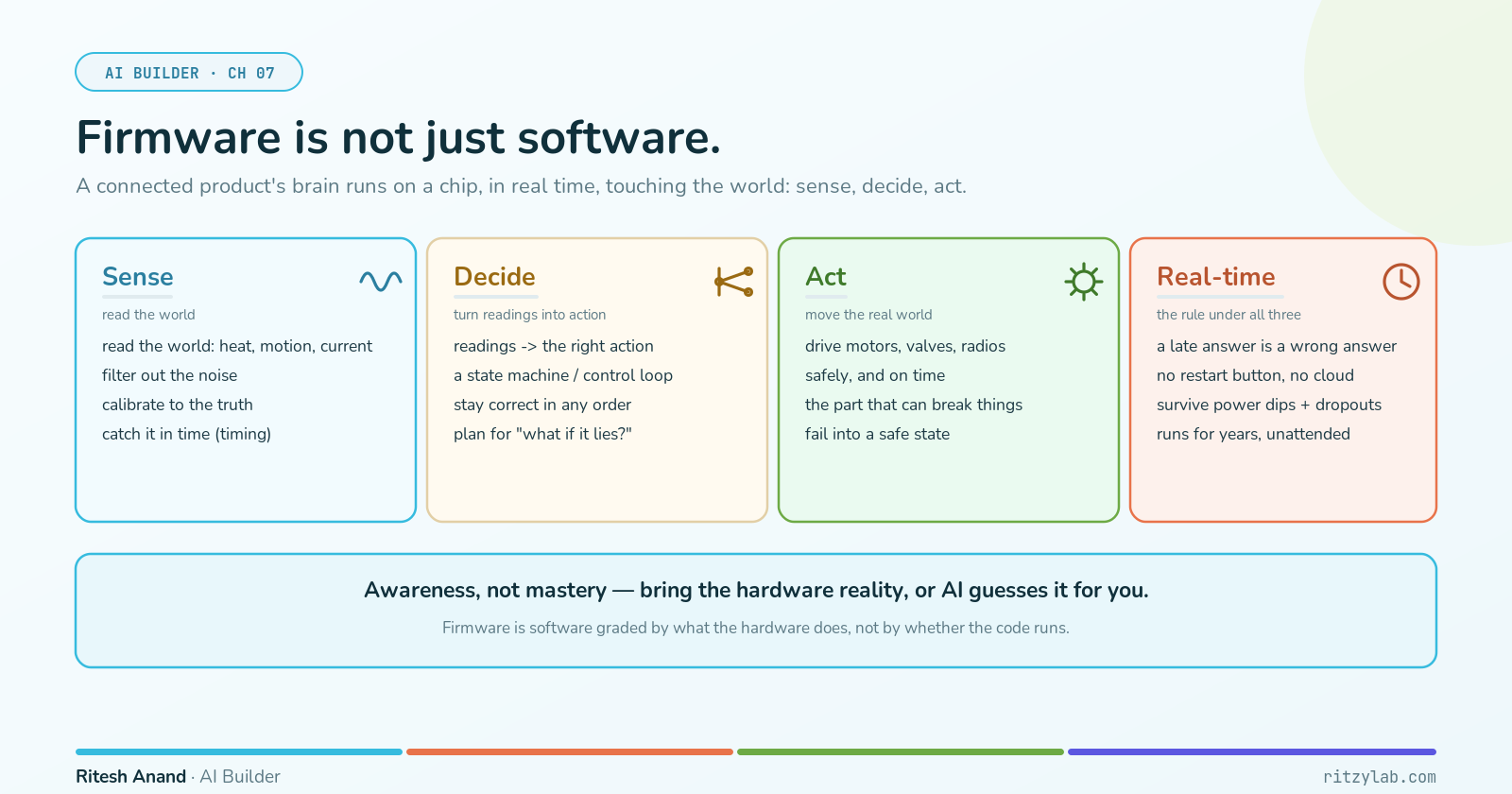
▸ First principle. Firmware is software graded by what the hardware does, not by whether the code runs.
2. Sense, decide, act is the whole loop
Strip away the jargon and almost every connected product is one loop, running forever: sense, decide, act.
Sense is turning messy physical reality — temperature, motion, current, pressure — into numbers you can trust. That's not "read the pin"; it's filtering out noise, calibrating to the truth, and sampling at the right moment. Decide is the logic that turns those readings into action: usually a state machine or a control loop that has to stay correct under every possible ordering of events, not just the happy path. Act is driving the real world — motors, valves, radios — safely and on time; it's the part that touches physics and can actually break things, so it needs safe states and limits. Underneath all three sits the constraint that makes it firmware and not an app: it must do this in real time, unattended, for years, and keep working when the network and the power don't cooperate.
▸ First principle. A connected product is this loop running forever, reliably — the rest is decoration.
3. Awareness, not mastery — and where AI helps vs bites
Here's the useful part for a builder who isn't a firmware specialist. You don't need mastery; you need enough awareness to ask the sharp questions: what happens if this sensor lies, if the power dips mid-write, if two events land at the same instant? Those questions are most of the value, and they're exactly what a non-specialist can learn to ask.
This is also where AI is both wonderful and dangerous. It's genuinely good at scaffolding drivers, boilerplate, and the shape of a control loop. It's dangerous when it invents a timing budget, ignores a hardware limit, or writes code that compiles cleanly and violates the datasheet — all delivered with total confidence. The fix is the same discipline as the rest of this series: bring the real constraints. Give the model the chip, the clock, the memory budget, the sensor's failure modes, and the safe states, and it becomes a strong partner. Withhold them, and it fills the gaps with plausible fiction.
▸ First principle. In firmware, AI amplifies whoever brought the hardware reality — bring it, or it guesses for you.
A prompt you can actually use
Here's a tested way to make AI safe on firmware: force it to surface the hardware reality before it writes a line of code, and to mark what it's guessing.
You are helping me design firmware for [device: what it does].
Before writing any code, list:
1. Target chip and its limits (clock, RAM, flash) — ask me if unknown.
2. The real-time deadlines: what must happen within what time budget.
3. Each sensor and how it could lie or fail (noise, dropout, out of range).
4. Each actuator and its SAFE state if something goes wrong.
5. Events that could arrive out of order or at the same time.
Then propose the control structure (state machine or loop) — still no code.
CHECK: mark every value above as [known] or [GUESSED], and flag anything
you invented. Do not write code until I confirm the list.
The [GUESSED] tag is the whole trick: it turns the model's confident gaps into a checklist you can verify, instead of bugs you discover in the field.
▸ First principle. Make AI declare its assumptions before it writes code, and its confidence stops being a risk.
Keywords
firmware, embedded systems, the sense-decide-act loop, real-time, control loop, state machine, sensors and actuators, AI for firmware, awareness not mastery, connected product development.
FAQ
What is firmware, in plain terms?
Firmware is the software that runs a device's brain — on a small chip, in real time, touching the physical world. Unlike an app, it's judged by what the hardware does (did the motor stop in time, did the reading stay accurate), not just by whether the code runs.
What is the sense-decide-act loop?
It's the loop underneath almost every connected product. Sense: turn physical reality into trustworthy numbers (filtering, calibration, timing). Decide: turn readings into action, usually a state machine or control loop that stays correct under any order of events. Act: drive motors, valves, or radios safely and on time. It runs forever, in real time.
Can AI write firmware?
AI is good at scaffolding drivers and boilerplate, but dangerous when it invents timing, ignores hardware limits, or writes code that compiles yet breaks the datasheet — confidently. Give it the real constraints (chip, timing budget, failure modes, safe states) and make it mark its guesses, and it becomes a strong partner rather than a source of field bugs.
Do I need to be a firmware engineer to build a connected product?
No — but you need awareness, not mastery: enough to ask what happens if a sensor lies, the power dips, or two events land at once, and enough to catch a wrong answer. That awareness is most of the value and is very learnable.
Part of the AI Builder series — it compiles into the Handbook. The longer story and how I work live on my profile. — Ritesh | ritzylab.com
Stay in the loop
New essays on embedded systems, firmware quality, and engineering craft. No noise.
Discussion
No comments yet. Be the first to share your thoughts.
Leave a comment