What this is. Opinion + Experience + Fact (50% opinion · 15% experience · 35% fact). Written in collaboration with AI — I discuss, I do not outsource.
For a decade the advice was "specialize." It was right — depth was scarce, and scarce is valuable. AI changed what's scarce. This is Part 1 of the AI Builder series: why range is the new moat, what a "generalist" means now, and how to build one — with a cheat-sheet and a tested prompt to place yourself.
"Jack of all trades, master of none" was said as a warning. For most of my career it was even good advice: the market paid for depth because depth was hard to get. You went deep, picked a niche, and became the person nobody could replace in that one corner. Whole-system builders — the ones who could see across corners — were quietly underrated the entire time.
Then AI moved the floor. Not by making anyone a master, but by putting a near-expert first draft in almost any domain one prompt away. When the scarce thing becomes abundant, its price falls — and something that used to be a liability becomes the edge. Let me walk through the shift, what the word "generalist" should mean now, and how to actually grow into one.
1. The decade of the specialist
Specialization won for a simple reason: depth was expensive. Becoming genuinely good at one thing — a language, a domain, a craft — took years, so the people who had it were rare, and rare is valuable. Career advice optimised for it: find your niche, go deep, own it.
It worked. It also had a blind spot. The builder who understood a little of everything — the product, the hardware, the cloud, the go-to-market — was treated as unfocused, when in fact they were the only one who could see how the pieces fit. The system-level view was undervalued precisely because depth was the thing being priced.
▸ First principle. When depth is scarce, depth is the moat — so the market pays for it and underrates everything else.
2. AI commoditised depth
AI's clearest effect is that it lifts the least-expert the most. In a field study of more than 5,000 support agents, the least-experienced gained about 34% while the top performers barely moved. It hands a non-expert a near-expert draft in almost any domain — a contract clause, a thermal calculation, a marketing plan — in seconds. What used to take years to earn now arrives on demand.
That does not make depth worthless; it makes it abundant. And the moment a scarce resource becomes abundant, it stops being the thing that sets you apart. The catch — the one from earlier in this series — is that AI is jagged: brilliant inside its frontier, confidently wrong just outside it, and silent about which side of the line you are on.
▸ First principle. When depth is on tap, depth stops being the moat — the edge moves to whatever is still scarce.
3. So range is the new scarcity
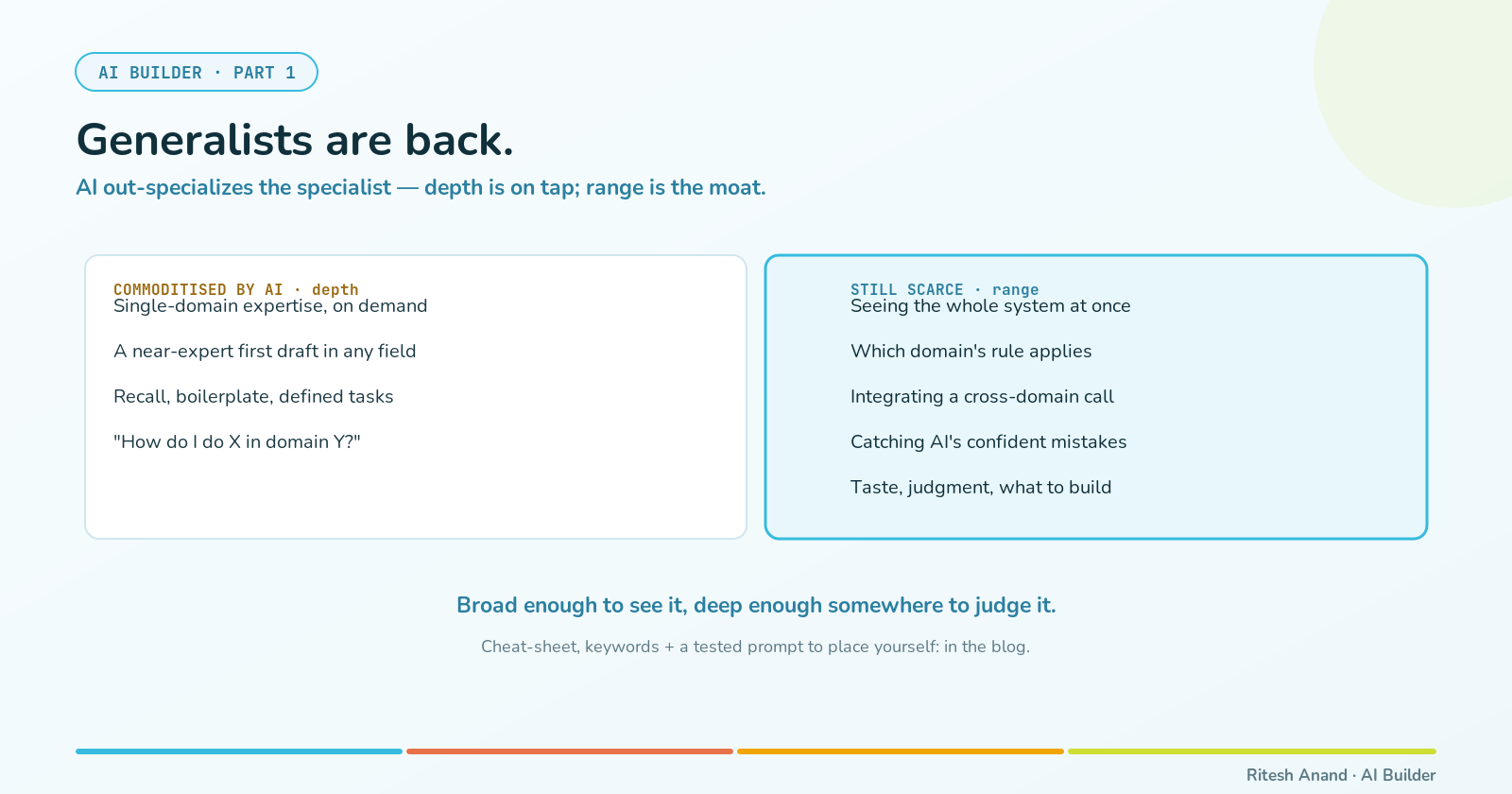
What is still scarce is the thing AI cannot supply: the map. AI cannot reliably span domains, tell you which domain's rule applies, integrate a decision that spans mechanical and cloud and finance at once, or notice that its own confident answer is wrong for your case. A human has to hold the whole system, route the work, and catch the mistakes. That human is a generalist.
This is not a call to be shallow. It is a call to be broad — to hold enough of each layer to direct AI into it and judge what comes back. The value has moved from "how deep can you go in one place" to "how much of the whole can you see and connect."
▸ First principle. AI supplies depth in any one domain; only a human supplies range across all of them — so range is what is now scarce.
4. What "generalist" means now
The word needs an upgrade, because "generalist" once meant "knows a little, masters nothing." The useful shape today is closer to a comb than a T: broad awareness across many layers, with a spike or two of real depth you earned the hard way. The breadth lets you see and route; the spikes give you the judgment to know when AI is wrong, because you have been wrong there yourself.
My own path is the ordinary version of this — deep in embedded, then curiosity into electronics, cloud, and the factory floor. None of it was mastery. All of it was enough to ask the right question and smell a wrong answer. That is the bar, and AI just lowered it from "a career" to "a season of curiosity."
▸ First principle. The modern generalist is broad with a spike or two — wide enough to connect, deep enough somewhere to judge.
5. How to grow your range — the prompt
Range is buildable, one layer at a time, and AI is the fastest teacher you have ever had for it. The move is to take a layer you keep handing off, and use AI to get fluent enough to hold it. Here is a tested prompt to place yourself first — where you already have range, and where AI is quietly doing depth you should understand:
You are a candid career and product coach who understands both deep
specialists and broad builders. Here is my situation:
[your role, what you build or want to build, and the 3-4 domains you
touch most, e.g. firmware, cloud, marketing, finance].

Do three things:
1. Map me on a "comb" - where I have real depth (spikes), where I have
   working awareness, and where I have a blind spot.
2. For each blind spot, tell me the ONE concept I'd need to grasp to
   direct and verify AI in that layer, and 3-5 keywords to learn it.
3. Tell me where I am probably leaning on AI for depth I don't understand
   well enough to catch when it's wrong - and what to shore up first.

Be specific and honest, not flattering. Rank the blind spots by how much
they limit me as a whole-system builder.
Run it, and treat the blind spots it ranks as your reading list. Each one is a layer of the stack from the last chapter — and a future chapter in this series.
▸ First principle. You grow range the way you build anything now: pick the layer that blocks you most, use AI to go deep fast, and verify until you can judge it yourself.
The specialists are not going away — some problems will always need someone ten years deep, and AI makes those people more productive, not less. But the person the next decade rewards is the one who can see the whole board and move AI across it. For a long time that builder was told to focus and narrow. The advice just flipped. Next in the series: the quiet skill that makes range actually pay off — awareness, and the context it lets you give AI.
Sources
AI lifts the least-experienced most (~+34%, experts ~flat) — Brynjolfsson, Li & Raymond, Generative AI at Work (NBER / QJE), 5,000+ support agents. The "jagged frontier" — Dell'Acqua, Mollick et al. (Harvard / BCG). Agent reliability on long, cross-domain, multi-step work remains limited today (multiple 2025-26 agent benchmarks), which is why human integration and verification still matter.
FAQ
Are generalists more valuable than specialists now?
For building and running whole products, increasingly yes — because AI has made single-domain depth abundant, and the scarce skill is now range: seeing the whole system, integrating across domains, and catching AI's mistakes. Specialists still matter for problems that need genuine ten-year depth; AI makes them more productive too. The shift is that breadth stopped being a liability and became an edge.
Why has AI made range more valuable than depth?
Because AI supplies depth in any one domain on demand, so depth is no longer scarce. What AI cannot reliably do is span domains, know which domain's rule applies, integrate a cross-domain decision, or notice when its own confident answer is wrong. Those require a human with range, which is now the scarce, valuable skill.
Does "generalist" mean being shallow?
No. The useful shape is broad awareness across many layers with a spike or two of real depth — a comb, not a flat line. Breadth lets you see and route the work; the deep spikes give you the judgment to know when an answer is wrong because you have been wrong there yourself.
How do I become a modern generalist?
One layer at a time. Take a domain you keep handing off, and use AI to get fluent enough to direct and verify it — not to master it, just to hold it. Pick the layer that limits you most, learn the one concept that unlocks it, and repeat. AI turns years of range-building into a season of focused curiosity.
This is Part 1 of the AI Builder series. The short version lives on my LinkedIn; the whole series — one layer at a time, each with its own cheat-sheet, keywords, and prompt — lives on my profile.
Stay in the loop
New essays on embedded systems, firmware quality, and engineering craft. No noise.
Discussion
No comments yet. Be the first to share your thoughts.
Leave a comment