What this is. Opinion + Experience + Fact (30% opinion · 40% experience · 30% fact). Written in collaboration with AI — I discuss, I do not outsource.
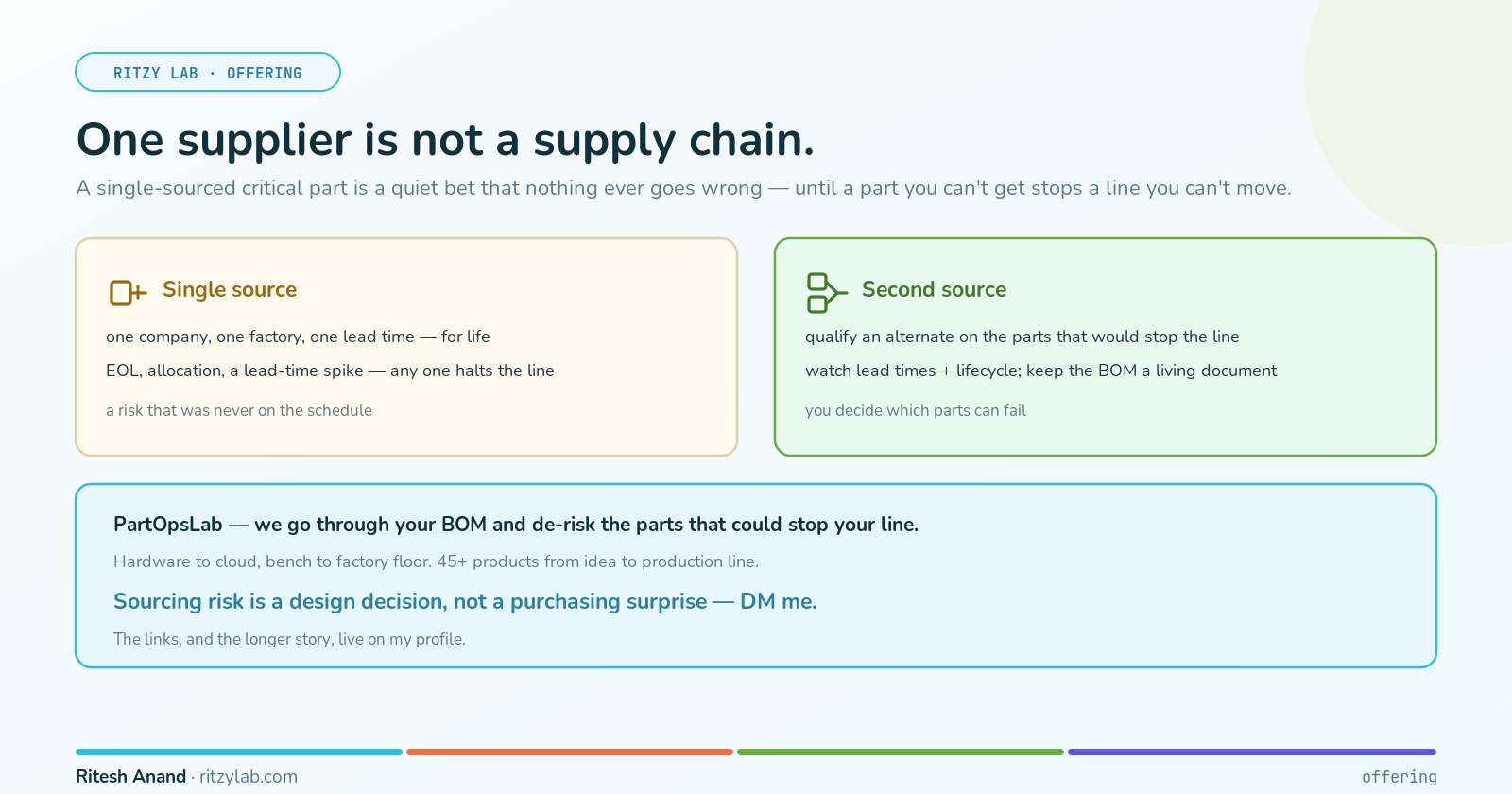
Why a single-sourced critical part is a risk hiding in plain sight, and how we de-risk a BOM before it stops a line. The short version: one supplier means one point of failure for the life of the product; resilience is designed into the BOM early by second-sourcing the parts that matter, not discovered in the middle of a crisis.
Every bill of materials has a few parts that quietly hold the whole product hostage. They're the ones with a single supplier, often chosen because that part was the best fit, the cheapest, or simply the one the reference design used. Nobody made a deliberate decision to bet the launch on one company — it just happened, one component at a time. And a single-sourced critical part is exactly that: a bet that nothing will ever go wrong with one company, one factory, and one lead time, for the entire life of the product.
That bet holds right up until it doesn't — and then a part you can't get stops a line you can't move. This is PartOpsLab, part of Ritzy Lab, and here's how we think about de-risking a BOM before it bites.
1. One supplier is one point of failure
The ways a single source fails are all ordinary. A part goes end-of-life. It goes on allocation and your order sits behind a bigger customer's. A fab has a fire, or a flood, or a geopolitical disruption. A lead time that was eight weeks quietly becomes forty. Any one of these, on a part with no qualified alternative, doesn't slow you down — it stops you, because you cannot ship a product missing a component. The maddening part is that the risk was present the entire time; it just wasn't written on any schedule, so nobody was watching it until it became a crisis.
▸ First principle. A critical part with one source is a launch date you don't fully control.
2. Resilience is designed into the BOM, not found in the crisis
The fix is unglamorous and it works: build the alternative before you need it. Second-source or qualify an alternate on the parts that matter, watch lead times and lifecycle status as living signals rather than one-time checks, and treat the BOM as a document that keeps changing after you "finish" it. The honest constraint is that you can't dual-source everything — qualification costs time and money — so the real skill is triage: identifying the handful of parts that, if they vanished tomorrow, would actually halt production, and de-risking those first. Everything else can tolerate a scramble; those cannot.
▸ First principle. You decide which parts can fail before the market decides for you.
3. Factory-floor experience, in the room early
Knowing which parts to worry about is judgment, and judgment comes from having been burned before. We've taken 45+ products from idea to production line, so "which parts do we de-risk, and how?" is a question we've answered many times — at design review, when it's cheap, rather than on the day a part goes on allocation, when it's ruinous. The cheapest time to find a single-source risk is while the design is still on the screen; the most expensive is the morning you try to place the order and can't.
▸ First principle. Sourcing risk is a design decision, not a purchasing surprise.
How we work
PartOpsLab, part of Ritzy Lab, goes through your BOM and de-risks the parts that could stop your line — before they do. Hardware to cloud, bench to factory floor, drawing on 45+ products taken all the way to production. If you're building hardware and carrying single-source risk you haven't mapped, that's the conversation we're built for. The links, and the longer story, live on my profile — or DM me.
FAQ
Why is single-sourcing a critical component risky?
Because it makes your ability to ship depend entirely on one company, one factory, and one lead time. If that part goes end-of-life, on allocation, or its lead time spikes, and there's no qualified alternative, production stops — you can't ship a product that's missing a component.
What is second-sourcing, and should I do it for every part?
Second-sourcing means qualifying an alternate supplier or component so you have a fallback. You can't afford to do it for every part, because qualification takes time and money. The skill is triage: identify the parts that would actually halt production if they disappeared, and second-source those first.
When is the right time to address sourcing risk?
At design review, while the design is still on the screen — that's when finding and fixing a single-source risk is cheapest. The most expensive time is the day you try to order the part and can't. Sourcing risk is best treated as a design decision, not a purchasing problem discovered later.
What does PartOpsLab do?
PartOpsLab, part of Ritzy Lab, reviews your bill of materials and de-risks the parts that could stop your production line — identifying single-source and lead-time risks and where to second-source — drawing on experience taking 45+ products from idea to production.
This is how we work at PartOpsLab, part of Ritzy Lab. If you're carrying single-source risk you haven't mapped, the longer story and how I work live on my profile. — Ritesh | ritzylab.com
Stay in the loop
New essays on embedded systems, firmware quality, and engineering craft. No noise.
Discussion
No comments yet. Be the first to share your thoughts.
Leave a comment