What this is. Opinion + Experience + Fact (25% opinion · 50% experience · 25% fact). Written in collaboration with AI — I discuss, I do not outsource.
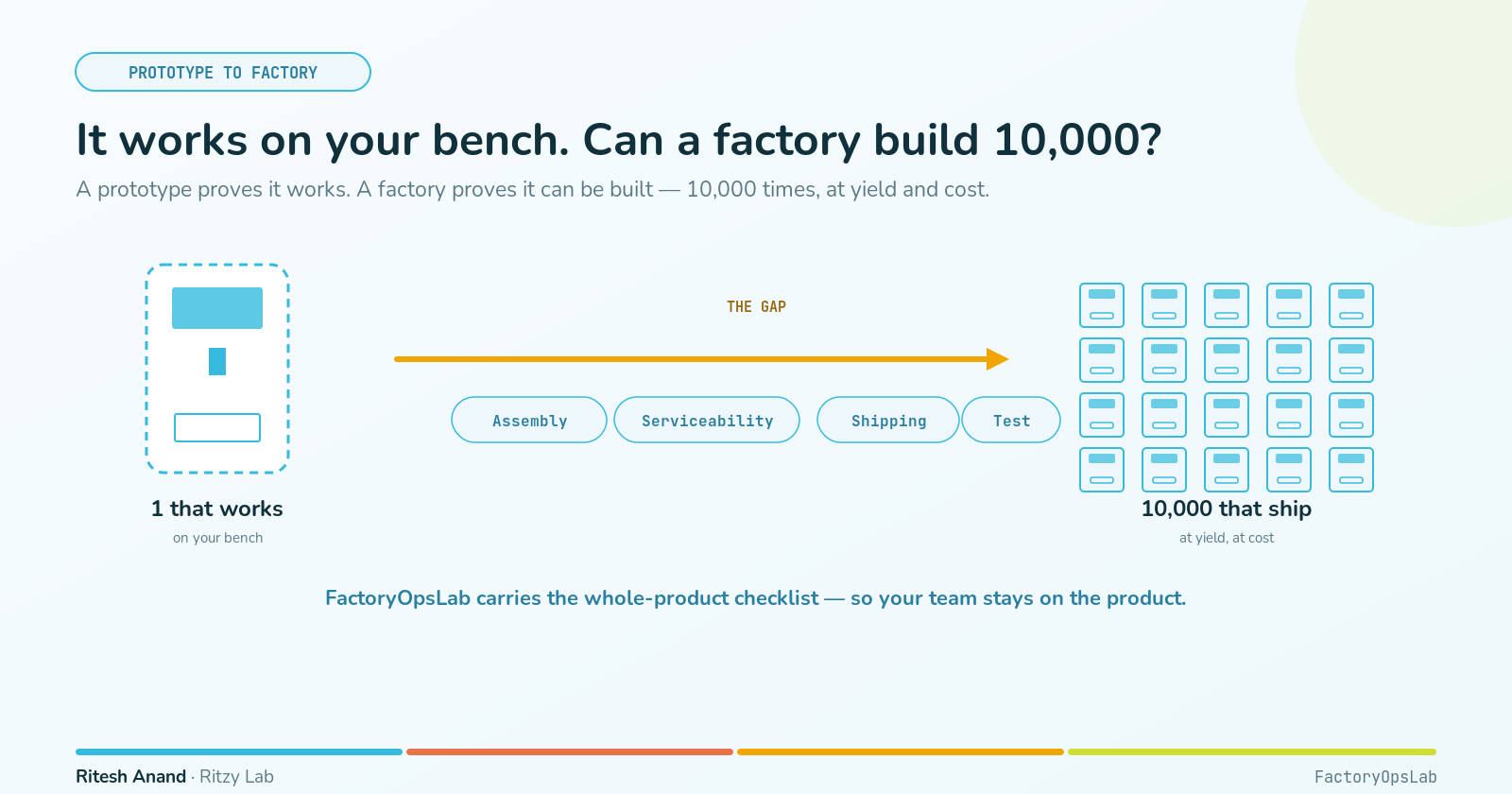
A working prototype proves your product can work — once, in your hands, with you standing there. Getting a factory to build it ten thousand times, at yield and at a cost that leaves margin, is a different problem, and it spans the whole product: the enclosure, the mechanism, the electronics, and the assembly line. Here is the gap most first-time hardware teams meet the hard way, laid out so you can design for it before the tooling is cut.
Picture a connected product with moving parts and a screen — a coffee machine, a vending unit, a smart appliance. On your bench it works: you assembled the one unit by hand, you know its quirks, and you are there to nudge the part that sticks. That proves the idea. It does not prove the product.
A factory has to build it without you — thousands of identical units, assembled by people who have never met it, on a line that has to hit a rate and a cost. The distance between "it works once" and "it can be built ten thousand times" is real, and it is mostly invisible from the bench. It is a set of decisions grouped under one umbrella engineers call Design for X — design for assembly, for manufacturing, for test, for service, for shipping. Let me walk the ones that most often ambush a first production run.
1. A prototype proves it works; a product proves it can be built
The first mental shift is the most important. A prototype answers "can this work?" A product answers "can this be built, by others, repeatably, at cost?" Those are different questions, and the industry has a ladder for crossing between them: EVT → DVT → PVT. Engineering Validation (does it work as intended?), Design Validation (does it work reliably, as designed, to spec?), and Production Validation (can the factory build it at rate, at yield, with production tooling and processes?). Each stage catches a different class of surprise, and skipping one just moves the surprise to a more expensive place.
▸ First principle. A prototype proves the idea; a product proves the build — and the build is the harder, later, more expensive problem.
2. Design for Assembly — every station is time, and time is cost
On a production line, a large part of your product's cost is simply how many hands touch it and for how long. Every assembly station is labor-seconds, a fixture, and a handoff where something can go wrong. So the single most effective cost lever is not a cheaper part — it is fewer parts and fewer operations.
That means designing the assembly, not just the product: reduce part count, cut the number and variety of fasteners, make parts self-locating and one-directional so a unit never has to be flipped mid-build, and add poka-yoke (mistake-proofing) so a part can only go in the right way. Anything that needs a skilled operator or a special tool is a cost and a yield risk multiplied by every unit you will ever make.
▸ First principle. Design the assembly, not just the product — every touch point you remove is margin you keep on every unit.
3. Design for Manufacturing — the parts have to be makeable at volume
The parts that were 3D-printed or hand-machined for the prototype have to become production parts, and that changes the rules. A plastic enclosure becomes injection-molded, which brings tooling (a real upfront cost, amortized over volume), and design constraints that did not exist on the printer: draft angles so parts release from the mold, uniform wall thickness to avoid sink and warp, and gate and cavity decisions that affect cost and cycle time. Sheet metal has its own bend radii and tolerances; the PCB needs proper spacing, test points, and panelization.
And then there is tolerance stack-up — the quiet killer. A mechanism you hand-fit once, adjusting as you went, has to work across thousands of units where every part varies within its tolerance band. Those variations add up, and a fit that was perfect on the bench binds or rattles at unit 400. Designing with the stack-up in mind, and specifying only the tolerances you actually need, is the difference between a smooth ramp and a mystery yield problem.
▸ First principle. A part that was made once by hand is not the same part made ten thousand times by a machine — design for the process and the tolerances, not the prototype.
4. Design for Test — every unit, in seconds
On the bench you are the test system: you power it up, watch it, and poke at it. A line has none of that. Every unit needs to be verified in seconds by an operator who is not an engineer, which means designing the test in: accessible test points, a functional test that exercises the real behavior, a way to calibrate and to program or flash firmware, and a golden sample to compare against. Test fixtures and jigs are their own small engineering project, and if the product was not designed to be testable, the line either slows to a crawl or ships defects.
▸ First principle. If you cannot test a unit in seconds without an engineer, you have not finished designing it for production.
5. Serviceability versus cost — decide it on purpose
How the product comes apart is a design decision with real money on both sides. Glue and ultrasonic-weld it shut and it is cheap to assemble and well sealed — but effectively unrepairable, so a single failure means a full replacement. Screw it together with a modular internal layout and it is serviceable and repairable — but that is more parts, more assembly time, and more cost. Neither is wrong. What is wrong is not choosing: if you do not decide deliberately, the easiest-to-assemble option quietly wins, and you discover the service cost after the product is in the field. Access to consumables and wear parts belongs in the same conversation.
▸ First principle. Serviceability versus cost is a deliberate design decision — make it early and on purpose, before the enclosure geometry locks it in.
6. Design for Shipping — the silent cost most teams find too late
Here is the one that surprises almost everyone, because it lives outside engineering entirely. Carriers do not price by the gram; they price in brackets. Nudge past a weight band — 2.0 kg into the next tier — and the cost of shipping every unit steps up. Worse, they bill the greater of actual weight and dimensional (volumetric) weight, computed from the packed box's size, so a light but bulky product ships as if it were heavy. A few millimeters of enclosure or packaging can move you across a boundary and add cost to every unit forever.
It compounds from there. How many units fit in a master carton, and how many cartons on a pallet, sets your freight cost per unit — a slightly smaller box can mean meaningfully more units per pallet. The packaging has to survive drop and vibration (there are standard test protocols for this) without over-packaging you into the next size up. And every country draws these lines differently, with its own brackets, duties, and — if there is a battery inside — dangerous-goods rules. The size and weight of the shipped box are set at design time, and they price every unit you ever make.
▸ First principle. The dimensions and weight of the packed box are a product spec — set at design time, they quietly price every unit and every market.
7. No one engineer sees all of this — and that is the real gap
Look back at that list: assembly, molding and tolerances, test, service, shipping — plus cost and supply at volume and the certifications (CE, FCC, UL and their regional equivalents) that have to be designed in rather than bolted on. No single engineer holds all of it. A firmware lead is deep in firmware; a mechanical engineer is deep in mechanics. Each is excellent, and each easily misses the lane next door — precisely because being a specialist means going deep in one place, not wide across all of them.
That is not a competence gap; it is a breadth gap. And breadth is cheap to apply at the whiteboard, where a comment costs a sentence, and brutally expensive to apply after the injection-mold tooling is cut, where a change costs weeks and real money. The teams that ramp smoothly are the ones where someone held the whole board early — carried the full Design-for-X checklist while the design was still on a screen.
That whole-product breadth — assembly, serviceability, shipping, test, compliance, and sourcing — is exactly what we do at FactoryOpsLab, Ritzy Lab's manufacturing practice: we hold the production checklist alongside your team so your engineers can stay focused on the product, not on discovering a shipping bracket or a tolerance stack-up at launch. If you have a prototype that works and a factory date ahead, that is a conversation worth having before the tooling is cut.
▸ First principle. Going to production is a whole-product problem — wider than any single specialty — so someone has to hold the whole board while it is still cheap to change.
A working prototype is a real achievement, and it is worth remembering what it did and did not prove. It proved the idea can work. The next job — the one that decides your cost, your timeline, and whether the first thousand units ship clean — is proving it can be built, by others, at volume. Design for that from the start, hold the whole checklist while the product is still on a screen, and the factory becomes a ramp instead of a wall.
Sources & notes
The frameworks here are standard hardware-development practice: Design for X (Design for Assembly / Manufacturing / Test / Service), the EVT → DVT → PVT validation ladder, tolerance stack-up, and end-of-line test. Shipping economics — carrier weight brackets and dimensional (volumetric) weight, master-carton and pallet efficiency, packaging drop/vibration testing, and country-specific duties and dangerous-goods rules for batteries — are established logistics practice; exact thresholds vary by carrier and country and should be checked for your product and lanes. FactoryOpsLab is Ritzy Lab's manufacturing practice for crossing prototype to production.
FAQ
What is the difference between a prototype and a production-ready product?
A prototype proves the idea can work — usually one hand-built unit, with the designer present to adjust it. A production-ready product proves it can be built repeatably by others, at a target yield and cost, using production tooling and processes. The gap between them covers assembly, manufacturable parts and tolerances, testability, serviceability, shipping, and compliance — most of which are invisible when you are looking at a single working unit on a bench.
What is Design for Assembly (DFA), and why does it drive cost?
Design for Assembly is designing the product so it is fast and error-proof to put together on a line. It matters because a large share of unit cost is labor — how many hands touch the product and for how long. Fewer parts, fewer fasteners, self-locating and one-directional parts, and mistake-proofing (poka-yoke) all cut assembly time and yield loss, so every touch point you remove is margin kept on every unit.
What is Design for Manufacturing (DFM) for a physical product?
DFM is designing each part so it can be made at volume with the chosen process. For an injection-molded enclosure that means draft angles, uniform wall thickness, and tooling and cavity decisions; for sheet metal, bend radii and tolerances; for a PCB, spacing, test points, and panelization. It also means designing with tolerance stack-up in mind, so a mechanism that fit by hand still fits across thousands of units where every part varies within its band.
What are EVT, DVT, and PVT?
They are the three validation stages between prototype and mass production. EVT (Engineering Validation Test) confirms the design works as intended. DVT (Design Validation Test) confirms it works reliably and meets specification. PVT (Production Validation Test) confirms the factory can build it at rate and yield using production tooling and processes. Each stage catches a different class of problem, and skipping one moves the surprise to a later, more expensive point.
How do shipping weight and size change a product's cost?
Carriers price in brackets, not smoothly, so nudging past a weight tier raises the shipping cost of every unit. They also bill the greater of actual weight and dimensional (volumetric) weight — derived from the packed box's size — so a light but bulky product ships as if it were heavy. Box size also sets how many units fit per carton and pallet, which drives freight per unit. Because the packed dimensions are fixed at design time, a few millimeters or grams can price every unit, and every country's brackets and duties differ.
How do I choose a contract manufacturer, and what does the handoff need?
Choose a CM whose strengths (volume, process, region, certifications) match your product, and give them a complete handoff package: mechanical drawings and tooling data, Gerbers and a full BOM, an assembly process and work instructions, a test specification, and a golden sample. Then plan for first-article inspection and a yield ramp — the first units off the line reveal fit, tolerance, and process issues the bench never could, so you validate on a controlled build before committing the whole run.
What do engineers most often miss going from prototype to production?
The lanes outside their specialty — because a specialist goes deep in one area, not wide across all of them. The common misses are assembly-station count (unit cost), tolerance stack-up, testability on the line, the serviceability-versus-cost tradeoff, shipping weight and size brackets, and designing certifications in rather than bolting them on. These are cheap to fix at the whiteboard and expensive after tooling is cut, which is why holding the whole Design-for-X checklist early is the real work of going to production.
The short version of this is on my LinkedIn. FactoryOpsLab is our manufacturing practice for crossing prototype to production — if you're staring at that gap, the details and a way to reach me live on my profile.
Stay in the loop
New essays on embedded systems, firmware quality, and engineering craft. No noise.
Discussion
No comments yet. Be the first to share your thoughts.
Leave a comment