What this is. Opinion + Experience + Fact (45% opinion · 15% experience · 40% fact). Written in collaboration with AI — I discuss, I do not outsource.
Everyone is chasing better prompts. The real edge is quieter: how much context you can give AI, and how well you can check what it hands back. This closes Part 1 of the AI Builder series — why context beats prompting, why awareness (not mastery) is the bar, and a reusable, tested prompt to make it concrete.
The most common question I get about AI is some version of "what's the magic prompt?" It is the wrong question. A clever prompt gets you a confident, generic answer fast. What turns that answer into a useful one is everything you bring to it: the constraint you are under, the domain rule that must hold, the failure mode you have already lived through. That is context — and it, not phrasing, is where the leverage is.
The second half of the edge is knowing enough to catch a wrong answer. AI is jagged: brilliant inside its frontier, confidently wrong just outside it, and silent about which side of the line you are on. So the skill that pays now is a specific kind of awareness — enough of each layer to direct AI into it and to judge what comes back. Let me make that concrete.
1. Prompts are cheap; context is the edge
Prompt phrasing has a low ceiling. Past "be specific" and "give an example," fiddling with wording yields less and less. Context has a high ceiling. The same model, handed the real constraints of your problem, produces a materially different answer — because you have narrowed it from "a plausible answer for anyone" to "the right answer for you."
Concretely: "write a firmware update routine" gets you a textbook loop. "Write a firmware update routine that must survive power loss mid-write on this flash part, must roll back on a bad image, and must fit in 12 KB" gets you something you can almost use — because the constraints, the failure mode, and the definition of done did the work, not the verb you chose.
▸ First principle. AI rewards the context you bring, not the wording you use — phrasing has a low ceiling, context has a high one.
2. Awareness, not mastery
Here is the freeing part: you do not need to master every layer a modern product touches. You need enough awareness of each to do two things — ask the right question, and spot a wrong answer. That is a much lower bar than mastery, and a much higher one than a good prompt.
Awareness is what lets you give context (you know which constraint matters) and what lets you verify (you know what a wrong answer looks like). It is the whole game with a jagged tool: the model will hand you something confident and plausible, and only your awareness of that layer tells you whether it is right for your case or quietly off.
▸ First principle. Enough awareness to direct and verify beats mastery you will never have — and beats a clever prompt every time.
3. Awareness is buildable — one layer at a time
The good news is that this is a skill, not a talent, and AI is the fastest teacher you have ever had for it. You do not build awareness across the whole stack at once; you build it on the layer that is blocking you, get fluent enough to direct and verify it, and move to the next. Each layer you pick up widens the set of problems you can hold end to end.
My own range came this way — deep in embedded, then curiosity into electronics, cloud, and the factory floor. None of it was mastery. All of it was enough to feel the jagged edge in that domain: to sense when an answer was confidently wrong because I had been wrong there myself.
▸ First principle. Awareness across the stack is the one advantage AI cannot hand you — so build it, one layer at a time.
4. The context checklist
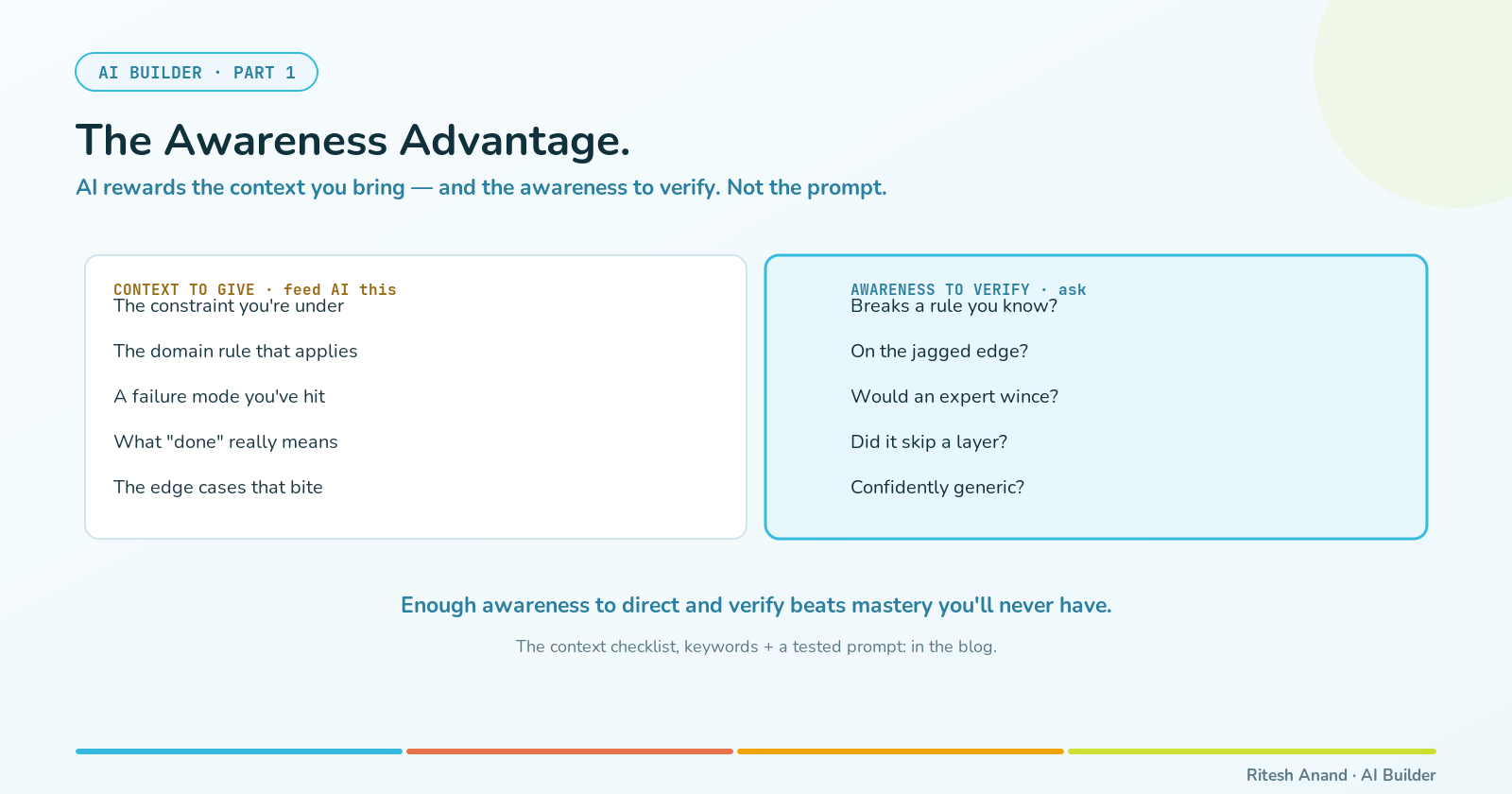
Before you ask AI for anything that matters, it is worth spending a minute assembling context and planning your check. The two columns below are the whole method: what to feed in, and what to ask yourself about what comes out.
▸ First principle. Assemble context before you ask, and plan your check before you trust — the method is the same on every layer.
5. The prompt — a context scaffold you can reuse
Here is a tested pattern that forces both halves: it makes you supply context, and it makes the model surface its own uncertainty instead of hiding it. Fill the brackets, and read the CHECK section as carefully as the answer.
You are helping me with [task] in [domain].

Context you must use:
- Constraint: [the hard constraint you're under]
- Rule that must hold: [the domain rule / regulation / invariant]
- A failure mode I've seen: [what has bitten me before]
- "Done" means: [your real definition of done]
- Edge cases that matter: [the inputs/conditions that break things]

First, draft the solution using that context.

Then, in a separate section titled CHECK:
1. List every assumption you made that I did not give you.
2. Name where you are least confident and most likely wrong for THIS
   case - not in general.
3. Say which kind of expert should review this before it ships, and why.

Be specific and honest, not reassuring.
The CHECK section is the point. A bare prompt gives you a confident answer and hides its assumptions; this makes them visible, so your awareness has something to catch. Run it on a layer you know well first — you will see how accurate its self-doubt is, and you will trust the pattern on layers you know less.
▸ First principle. Give strong context, then make the model show its assumptions and its doubt — so verification has a target.
Better prompting is a rounding error next to better context and better checking. The builders who win with AI are not the ones with the cleverest wording; they are the ones who bring the real constraints of their problem and who know enough of each layer to catch a confident mistake. That awareness is buildable, one layer at a time — which is exactly where this series goes next: the whole stack, mapped, one layer per chapter, with the awareness each one takes.
Sources
The "jagged frontier" — AI strong inside its frontier and confidently wrong just outside it — is from Dell'Acqua, Mollick et al. (Harvard / BCG), "Navigating the Jagged Technological Frontier." "Context engineering" (supplying constraints, rules, and examples rather than tuning phrasing) is an emerging practitioner term, not a measured statistic; the claims here are method, not benchmark. Agent reliability on long, cross-domain work remains limited today, which is why human verification still matters.
FAQ
What is context engineering, and how is it different from prompt engineering?
Prompt engineering is about the wording of your request; context engineering is about the information you supply with it — the constraints, domain rules, failure modes, and definition of done that narrow a generic answer into a correct one for your case. Phrasing has a low ceiling; context has a high one, which is why context is the larger lever.
Do I need to be an expert to use AI well?
No — you need awareness, not mastery. Enough of each layer to ask the right question and to recognise a wrong answer is a much lower bar than expertise, and a much higher one than a good prompt. That awareness is what lets you both give context and verify output.
How do I catch when AI is confidently wrong?
Plan the check before you trust the answer: ask whether it breaks a rule you know, whether it is on the "jagged edge" of the model's competence, whether an expert would wince, whether it skipped a layer, and whether it is merely confidently generic. Prompts that force the model to list its assumptions and its least-confident points make those mistakes visible.
How do I build awareness across many domains?
One layer at a time. Take the layer that blocks you most, use AI to get fluent enough to direct and verify it — not to master it — and move on. Each layer widens the set of problems you can hold end to end, and AI turns what used to take years into a season of focused curiosity.
This closes Part 1 of the AI Builder series. The short version lives on my LinkedIn; the whole series — one layer at a time, each with its own cheat-sheet, keywords, and tested prompt — lives on my profile.
Stay in the loop
New essays on embedded systems, firmware quality, and engineering craft. No noise.
Discussion
No comments yet. Be the first to share your thoughts.
Leave a comment