What this is. Opinion + Experience + Fact (30% opinion · 40% experience · 30% fact). Written in collaboration with AI — I discuss, I do not outsource.
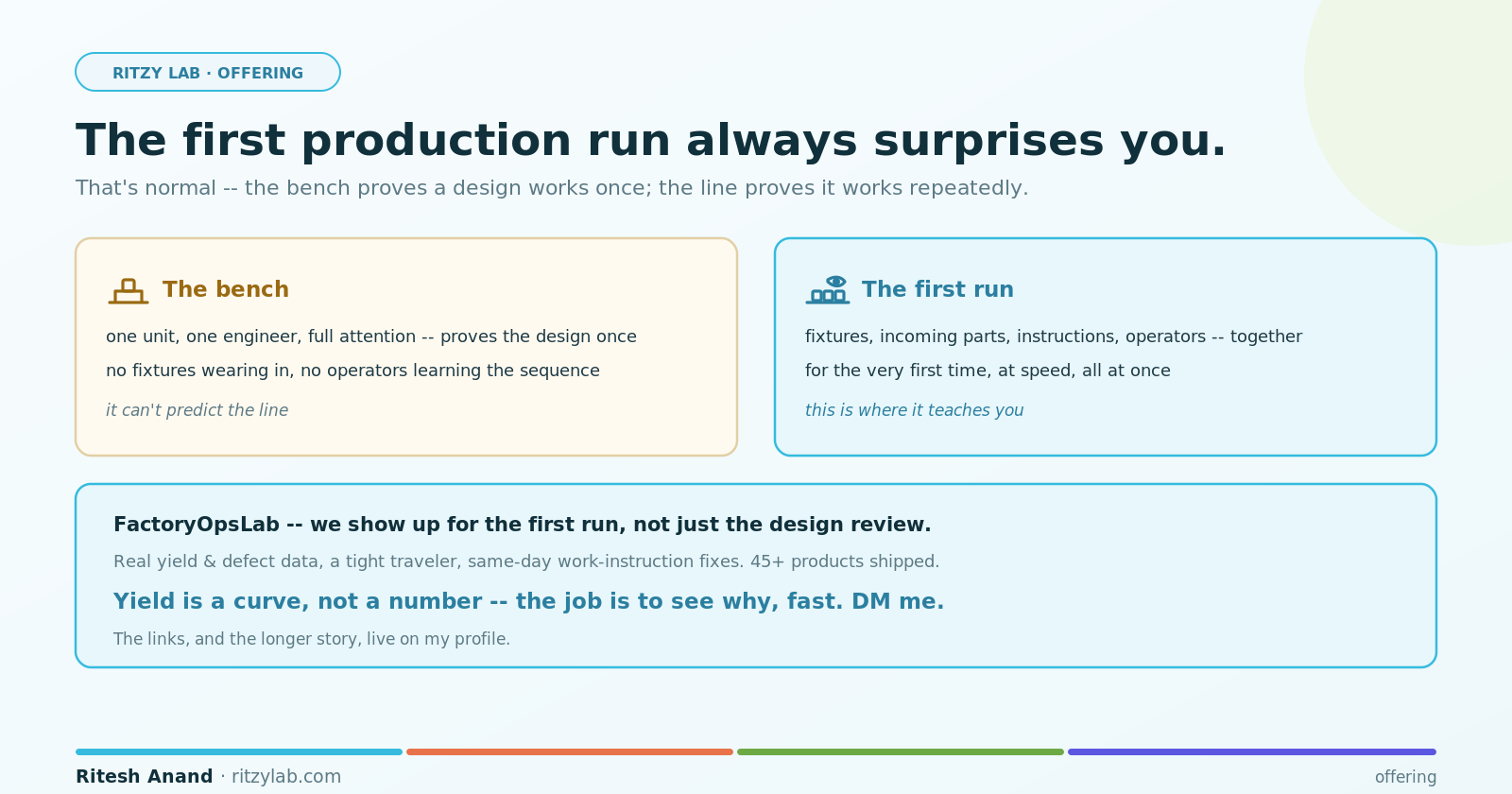
Why the first real production run always turns up something validation didn't catch, and why that's normal rather than alarming. The short version: EVT and DVT prove the design works; the first run is the first time the design, the tooling, the work instructions, and the operators all run together — and it always finds something the earlier stages couldn't.
Every first production run turns up something nobody wrote down beforehand. That is not a sign the program is behind — it is the normal, expected shape of the thing. Engineering Validation and Design Validation (EVT/DVT) prove that the design itself works. They don't prove that a line of fixtures, incoming parts, work instructions, and operators will build it the same way, over and over, at speed. The first production run is the first time all of that runs together, and it is where the real education starts.
1. The bench doesn't predict the line
A unit built by an engineer on a bench, by hand, with full attention, is not the same event as unit 200 built by an operator on a fixture at takt time. Tooling has a wear-in period. Incoming components carry variation the validation batch didn't happen to include. Work instructions written by someone who has built the product once are being followed, for the first time, by someone who has never built it at all. None of that is a failure of planning — it's what a first run is for. The bench proves the design can work. The line is where you find out how it actually behaves at volume.
▸ First principle. Validation proves the design works once; the first run proves it works repeatedly, under real conditions.
2. Yield is a curve, not a number
Nobody hits target yield on unit one, and expecting to is the wrong benchmark entirely. The honest shape is a ramp: early units teach the line what "correct" actually looks like, defects get traced to a specific cause, that cause gets fixed, and yield climbs as the list of open causes shrinks. The real risk on a first run isn't a low yield number — a low number is expected. The risk is not having a way to see why yield is low, fast enough to fix the cause before the next batch repeats the same defect at the same rate.
▸ First principle. The first run's job is to teach you where the process breaks, not to hit a target.
3. The traveler catches what the work instructions missed
Work instructions get written before anyone has built the product at volume, so the gap between the instruction and reality doesn't show up in a document review — it shows up as confusion on the line. A traveler, the record that follows each individual unit through every station, is what turns a vague "something felt off around unit 47" into a specific, traceable step: which station, which fixture, which operator, which lot of incoming parts. Without that record, the same ambiguous problem just keeps recurring under a different name.
▸ First principle. The paperwork that tracks each unit is what turns a vague feeling into a fixable cause.
How we work
FactoryOpsLab, part of Ritzy Lab, shows up for the first production run itself, not just the design review before it. Our job is to instrument the line for real yield and defect data, keep the traveler tight enough to actually trace a problem to its station, and close the loop on work-instruction corrections the same day a gap surfaces — not next sprint. Hardware to cloud, bench to factory floor, drawing on 45+ products taken from idea to production line: the first run is where the real education happens, and being there for it is worth more than another round of design review. If your first production run is coming up and you want someone who's watched this pattern before in the room, that's the conversation we're built for. The links, and the longer story, live on my profile — or DM me.
FAQ
What is a "first production run" in manufacturing?
It's the first time a product is built at production intent — real tooling, real work instructions, real operators — after design validation (EVT/DVT) is complete. It's the first test of the whole process running together, not just a test of the design.
Why is yield low on the first production run?
Because the process hasn't been tuned yet: tooling is wearing in, work instructions haven't fully met reality, and operators are still learning the sequence. Yield typically ramps up as these causes are found and fixed, rather than starting at target on unit one.
What is a traveler, and why does it matter on a first run?
A traveler is the record that follows each unit through every production station, capturing what happened at each step. On a first run, it turns a vague "something felt off" into a specific, traceable step — which station, which fixture, which lot — that can actually be fixed.
How do you prepare for surprises in a first production run?
Not by trying to eliminate them before day one — that isn't realistic. The preparation is building the feedback loop that catches them fast: instrumented yield and defect tracking, a tight traveler, and a same-day process for correcting work instructions as gaps surface.
This is how we work at FactoryOpsLab, part of Ritzy Lab. If your first production run is ahead of you, the longer story and how I work live on my profile. — Ritesh | ritzylab.com
Stay in the loop
New essays on embedded systems, firmware quality, and engineering craft. No noise.
Discussion
No comments yet. Be the first to share your thoughts.
Leave a comment