What this is. Opinion + Experience + Fact (45% opinion · 30% experience · 25% fact). Written in collaboration with AI — we discuss, we do not outsource.
From Ritzy Lab — introducing PartOpsLab, our engineer-led part sourcing, verification, and bench-test service.
1. The tax nobody puts on the schedule
A hardware team's most expensive people spend a surprising share of their week not designing the product. They are chasing a distributor for stock, comparing two datasheets line by line, waiting on a sample, or wiring up a quick rig to prove a motor actually does what its spec sheet claims. None of it shows up as a line item. All of it is real, and it comes straight out of the time your best engineers should be spending on the thing only they can build.
We call it the sourcing tax. It is the quiet overhead of getting the right parts, verified, into the design — and on a small team, where the person sourcing the part is also the person architecting the system, it is one of the most expensive taxes there is.
The tax is not a sign anyone is doing the job badly. It is structural. Sourcing and verification genuinely have to happen, and on a lean team there is no one else to do them, so they land on the engineers by default. The cost is invisible precisely because everyone treats it as "part of the job" rather than as work that could be owned by someone else.
▸ First principle. Sourcing work is real work. On a small team it lands on your most expensive people by default — and that default is a choice you can change.
2. Why sourcing is harder than it looks
It would be one thing if a part were just a part. It is not. The market underneath your BOM is noisier and riskier than it has ever been, and that noise is exactly what eats the hours.
Counterfeit and mislabeled components are not a fringe problem. Industry reporting put counterfeit-part incidents at a nine-year high, with the Electronics Reseller Association International recording roughly a 25% jump in reported counterfeits in 2024 over the year before — and estimated losses to the electronics sector running into the tens of billions of dollars a year. Tellingly, more than a quarter of those cases involved active parts that were readily available through authorized channels, which means scarcity is not the only thing driving it. The moment a team reaches outside authorized distribution to hit a deadline — an independent broker, a marketplace listing, a "we have stock" email — the traceability gets thinner and the risk of a relabeled, refurbished, or substituted part goes up.
Layer on top of that the ordinary friction: lead times that swing from days to a year on the same part, minimum order quantities that do not match a pilot build, a vendor claim that needs a bench to confirm, a second-source substitution that has to be checked for fit. Every one of those is a small investigation. Run enough of them and you have spent a sprint on parts instead of product.
▸ First principle. A part is a claim until someone verifies it. The cost of believing the wrong claim shows up late, in the field, where it is most expensive to fix.
3. The benefit: keep your engineers on the product
Here is the reframe. The goal is not to make your engineers faster at sourcing. It is to take most of the sourcing off them entirely, so their attention goes back to the product.
This is the whole idea behind Ritzy Lab: a customer's core engineers should stay on the core product, and the surrounding engineering work — the work that is critical but not the thing that makes the product yours — can be owned by someone whose actual job it is. Parts are one of the clearest cases. Finding a supplier, confirming a lead time, inspecting a sample, building a small rig to prove basic function, and writing down the evidence is bounded, repeatable, engineer-grade work. It does not need to be done by the person holding the architecture in their head. It just needs to be done well, and handed back as a clear answer.
The benefit compounds. An engineer who is not context-switching into sourcing three times a day holds the design in their head longer and ships it sooner. And the answers come back with evidence attached, so the decision to commit to a part is made on a bench result and a paper trail, not on a vendor's word and a hope.
▸ First principle. The win is not faster sourcing. It is your engineers never having to do it — and getting a verified answer back instead of a claim.
4. What PartOpsLab actually does
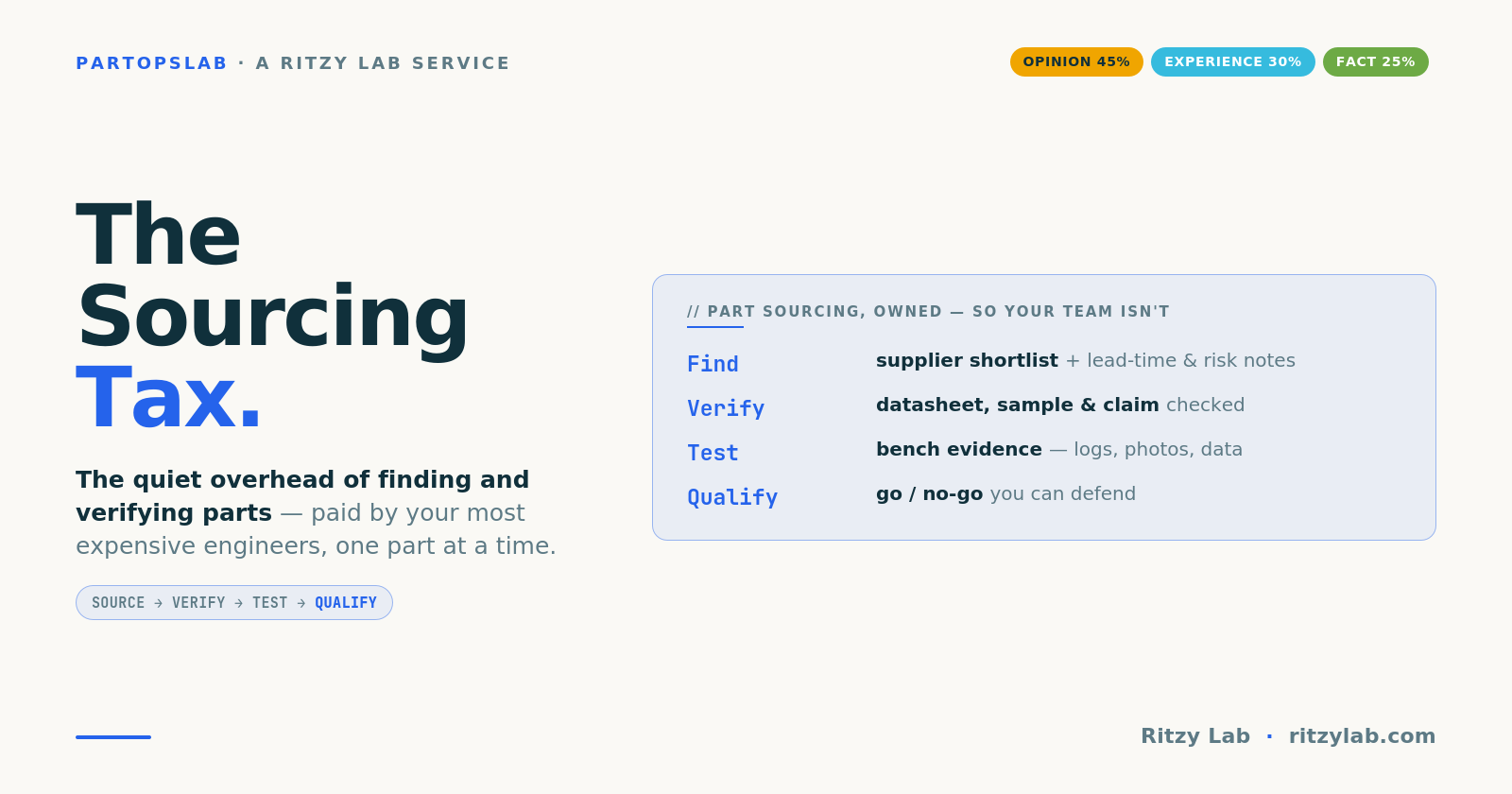
PartOpsLab is the engineer-led service that owns that work. You can enter at any stage — "find this part or an equivalent," "compare these suppliers," "verify this vendor claim," "bench-test this sample," "tell me if this is good enough for our design" — and we take it from there. Four loops cover it:
| Loop | What we do | What you get back |
|---|---|---|
| Find | Supplier and distributor search across India/Asia/China desks, availability and lead-time checks, MOQ and pricing signals, substitution options | A shortlist with risk notes |
| Verify | Datasheet and vendor-claim review, sample inspection, basic electrical/mechanical fit checks, certificate review where it applies | A clear verified / not-verified answer |
| Test | Bench-test plan, manual tests, simple controller-based rigs and firmware, logs, photos, measurements | Evidence you can act on |
| Qualify | Recommendation summary, risk rating, pass/fail notes, next-step guidance | A go / no-go you can defend |
It is AI-assisted and human-reviewed: AI helps with the search, the datasheet parsing, and the first-pass evidence draft; the engineering judgment, the bench, and the final recommendation stay with a person who has done it before. We are not a procurement department, a certified test lab, or a compliance authority — we are the engineer-led support that gives a hardware team clear answers before parts slow the product down. Pricing is simple: a free triage call to decide whether it is even a good fit, then you pick the loop and the delivery desk that match your budget. Start with one part. Expand only when it saves you time.
▸ First principle. Buy back your engineers' attention one part at a time. The right unit of help is a single clear answer, with evidence, delivered by someone who has done it before.
So before the next sourcing question pulls an engineer off the product: who on your team is paying the sourcing tax this week — and what would they build instead if they didn't have to?
Start with a free triage call → cal.com/ritzy · partopslab.com
Labeled: Opinion + Experience + Fact (45% opinion · 30% experience · 25% fact)
Sources:
- ERAI / counterfeit-parts reporting at a nine-year high; ~25% increase in 2024
- Counterfeit electronics — annual losses and supply-chain risk
- Are counterfeit PCBA parts still a risk in 2025 — drivers and mitigation
(Written in collaboration with AI — we discuss, we do not outsource.)
— Ritzy Lab | ritzylab.com · PartOpsLab
#HardwareEngineering #Sourcing #SupplyChain #ElectronicComponents #ProductDevelopment
Stay in the loop
New essays on embedded systems, firmware quality, and engineering craft. No noise.
Discussion
No comments yet. Be the first to share your thoughts.
Leave a comment