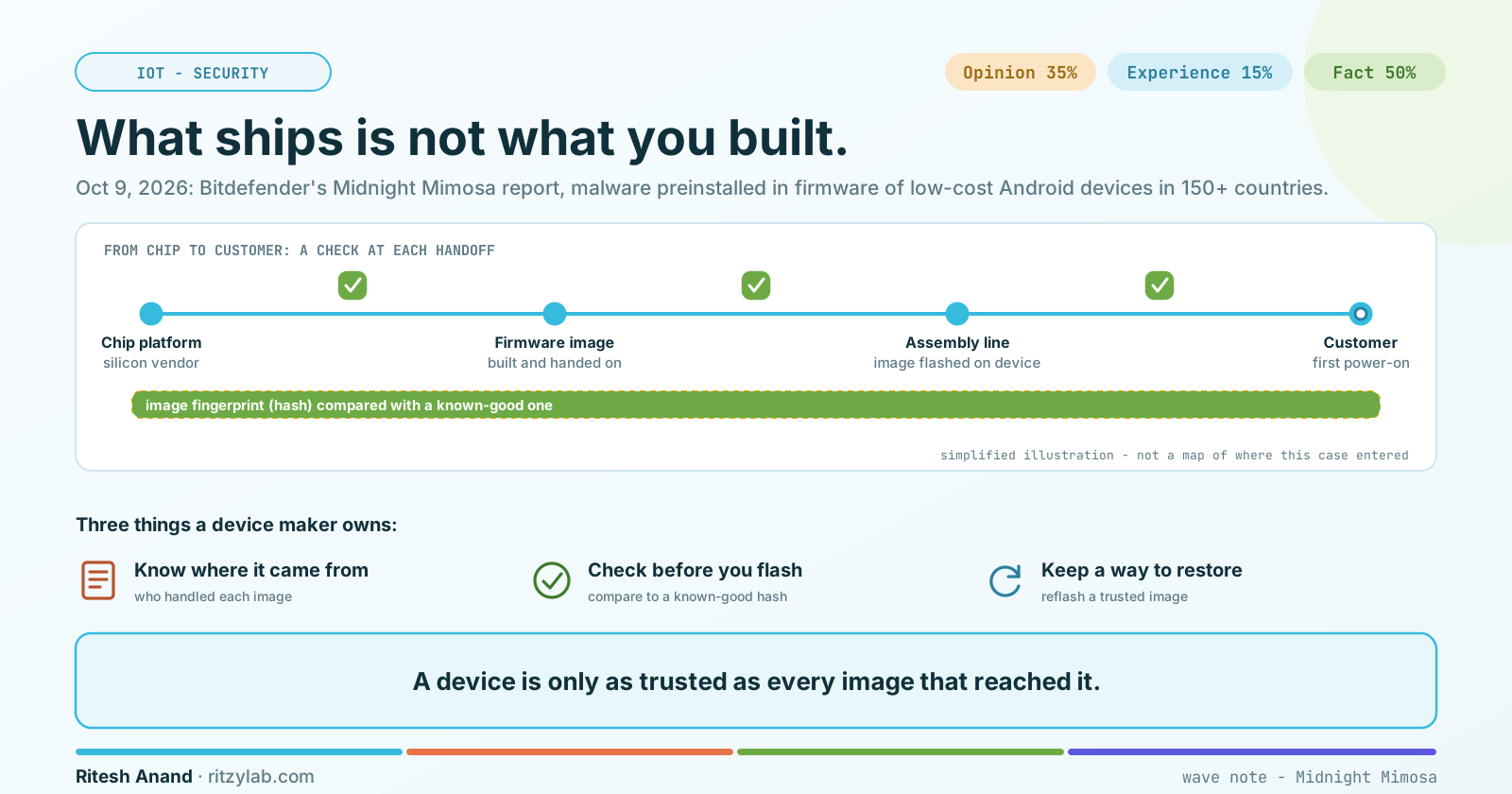
What this is. Opinion + Experience + Fact (35% opinion · 15% experience · 50% fact). Written in collaboration with AI — I discuss, I do not outsource.
A wave note on Midnight Mimosa. On October 9, 2026, SecurityWeek reported Bitdefender's findings: malware preinstalled in the firmware of low-cost Android devices built on MediaTek platforms, seen on thousands of devices in more than 150 countries. What ships is not always what you built, so a device is only as trusted as every image that reached it.
On October 9, 2026, SecurityWeek reported that Bitdefender had analyzed a firmware-level Android malware campaign it calls Midnight Mimosa. It affects low-cost Android devices built on MediaTek platforms. Bitdefender observed thousands of unique affected devices in more than 150 countries. (Firmware is the software baked into a device. A system app is one that ships as part of that firmware, so a normal user cannot uninstall it.)
The question worth sitting with is a simple one: how does code get onto a device before its owner ever switches it on? That is what this post is about, and what a device maker can do about it.
1. What did Bitdefender find in Midnight Mimosa?
Bitdefender found malware that is preinstalled in device firmware, so it is present from the first power-on. No one has to click a link or install an unsafe app. It runs with system-level privileges. According to the reporting, it can silently install and remove apps, grant permissions and load code supplied remotely from a command server.
The reported uses are ad fraud, automated click fraud, proxy-network abuse and botnets that can be rented out to others. Bitdefender also found a set of apps on Google Play that share the same ad-fraud code; those lack the privileged access of the firmware version and need to be installed by a user.
Two details matter for honesty. First, the reporting says where in the supply chain the code entered has not been determined, and attribution is unresolved. Some firmware carried certificates naming a company, and the report is explicit that this does not prove that company wrote or knowingly shipped the malware. Second, Bitdefender has not published a complete list of affected models. So this is not a story about one brand to avoid. It is a story about a layer of the product that is easy to take for granted.
▸ First principle. A device is only as trusted as every image that reached it.
2. Why doesn't a factory reset remove firmware-level malware?
Because it lives in the system partition, the protected storage area that holds the device's operating software. A factory reset clears user data and apps. It does not rewrite the system image. The reporting says a factory reset may not remove firmware-embedded malware, and that proper remediation may mean reflashing a trusted, clean firmware. If none is available, the advice given is to avoid sensitive use of the device and replace it.
For a device maker, that sentence carries a design lesson. When the image itself is the problem, the fix is a trusted image and a way to put it on the device. A product that has both can recover. A product that has neither depends on its owners to notice and replace it.
▸ First principle. Recovery is a feature you design before you need it.
3. What can a device maker own across the supply chain?
Four things sit with the team that ships the device. From my years around contract manufacturing lines, the lesson is the same each time: the handoffs are where trust is either checked or assumed.
Provenance. Know who built, changed or handled each firmware image before it reaches your line. This is the thread of know what you shipped and your firmware is not just your code.
A check before flashing. Compare each image to a known-good fingerprint (a hash, a short value computed from the file's exact contents) before it goes onto a device. If a single byte differs, the fingerprint differs.
A field path. Keep a way to reflash a trusted image onto devices already sold. The earlier posts a patch is not a recovery and a 2021 CVE is not old news make the same point from two other directions: a fix has to reach the device.
A behavior record. In EmbedIQ, the open framework I work on, each task is a single thread with a table-based state machine and one message queue, and the Observatory records every transition, message and fault. That gives you facts about what a device did. It is a record of device behavior, not a malware scanner, and it does not replace verifying images. Board-specific bring-up and drivers remain your work.
▸ First principle. Verify at every handoff, not only at the last one.
The copyable part: a "what reaches my device?" checklist
| Question | What "yes" looks like | Who owns it |
|---|---|---|
| 1. Do we know every party that builds or modifies our firmware image? | A short written list: silicon vendor, board-support code, contract manufacturer, any other intermediary | Firmware + operations |
| 2. Is each release image tied to a known-good fingerprint? | A hash recorded at release, stored somewhere the line cannot edit | Firmware |
| 3. Does the factory compare each image to that fingerprint before flashing? | A check in the programming step that blocks a mismatch | Manufacturing |
| 4. Can we read back what a finished device is actually running? | A build or image identity the device can report | Firmware |
| 5. Can we reflash a trusted image onto devices already sold? | A tested recovery path, not only an upgrade path | Firmware + cloud |
| 6. Do we have a record of normal device behavior? | A baseline of states, messages and faults, so a change stands out | Firmware |
| 7. Who decides when a supplied image is no longer trusted? | One named owner and one page of facts ready before it happens | Product lead |
Hardware and firmware leads: at which handoff do you verify a firmware image, and what does the check compare it against?
Next in this thread: how a product team decides which supplied components deserve a second look before they reach the line.
Sources
News and analysis: SecurityWeek — Pre-Baked Firmware Malware Hits Budget Android Devices in 150+ Countries (October 9, 2026: Bitdefender analysis; MediaTek-based low-cost devices; thousands of unique devices in more than 150 countries; preinstalled during manufacturing or supply; system privileges; ad fraud, proxy and botnet uses). The420.in — Budget Android Phones Found Shipping With Preinstalled Malware Across 150 Countries (entry point in the supply chain not determined; attribution unresolved; reflashing trusted firmware may be needed; factory reset may not remove it). TechRadar — Experts warn cheap Android phones are being shipped with malware built in (October 12, 2026: firmware-level cleanup may be needed). I did not locate Bitdefender's original report, so every figure here is the news sources' own. The figures are theirs; the reading of them, and the design position, are mine.
FAQ
What is Midnight Mimosa?
Midnight Mimosa is the name Bitdefender gave a firmware-level Android malware campaign, reported by SecurityWeek on October 9, 2026. The malware is preinstalled in the firmware of low-cost Android devices built on MediaTek platforms, with thousands of unique devices seen in more than 150 countries.
Can a factory reset remove preinstalled firmware malware?
Not necessarily. The reporting says a factory reset may not remove malware that lives in the system partition, and that proper remediation may require reflashing a trusted, clean firmware.
How can malware be on a device before the owner uses it?
If code is added to a firmware image during manufacturing or somewhere in the supply chain, it is present at the first power-on. In this case, the reporting says where it entered has not been determined.
What should device makers do to protect their firmware supply chain?
Know who builds or changes each firmware image, compare every image to a known-good fingerprint before flashing, be able to read back what a finished device runs, keep a way to reflash a trusted image onto devices already sold, and keep a record of normal device behavior.
Labels: Opinion 35% · Experience 15% · Fact 50%. Written in collaboration with AI — I discuss, I do not outsource.
This is a Ritzy Lab wave note. If you ship connected devices and want to compare notes on verifying what reaches the line, the longer story and how I work live on my profile. — Ritesh | ritzylab.com
#EmbeddedSystems #IoTSecurity #Firmware #EmbedIQ
Stay in the loop
New essays on embedded systems, firmware quality, and engineering craft. No noise.
Discussion
No comments yet. Be the first to share your thoughts.
Leave a comment