What this is. Opinion + Experience + Fact (30% opinion · 35% experience · 35% fact). Written in collaboration with AI — I discuss, I do not outsource.
Why every cryptographic key a connected device ships with will eventually need to change — and how to rotate keys across a fleet without stranding or bricking devices. The short version: you don't get to decide whether a key changes, only whether you're ready when it does. Design rotation before the first unit ships.
Every connected device ships with secrets: an identity certificate, a signing key, an API token, a key that verifies firmware updates. It's tempting to treat them the way we treat a serial number — burned in once at the factory, true for the life of the product. That assumption is one of the quieter ways a fleet gets into trouble, because keys are not permanent, and a device that lives in the field for years will outlast at least one of them.
The good news is that key rotation is a solved discipline — as long as you design for it up front. The trap is discovering you need it after you've shipped a million units that have no safe way to change their keys. Here's how I think about it.
1. Every key has an expiry, even if you didn't set one
Keys change for reasons outside your control. A private key gets compromised. A certificate reaches its expiry date. A signing algorithm ages out of what's considered secure, or a standard you rely on gets deprecated. Any one of these forces a change, and over a product lifetime measured in years, at least one of them will happen. Treating a shipped key as permanent doesn't make it permanent — it just means the change, when it comes, arrives as an emergency instead of a plan.
So the honest framing is: you never actually decided your keys were permanent. You only decided whether the product could survive them changing. Shipping without a rotation path is shipping a time bomb with a long fuse — it goes off on someone else's schedule, usually the worst possible one.
▸ First principle. You don't get to decide whether a key changes — only whether you're ready when it does.
2. Rotating across a fleet is where it gets hard
Rotating a key on one device on your bench is trivial. Rotating across a fleet is a different problem, because a fleet is never uniform: some devices are offline, some are on old firmware, some are in places you can't physically reach, and they don't all wake up at the same time. A rotation designed as a single synchronized cutover — everyone moves from key A to key B at once — will strand every device that wasn't listening at that moment.
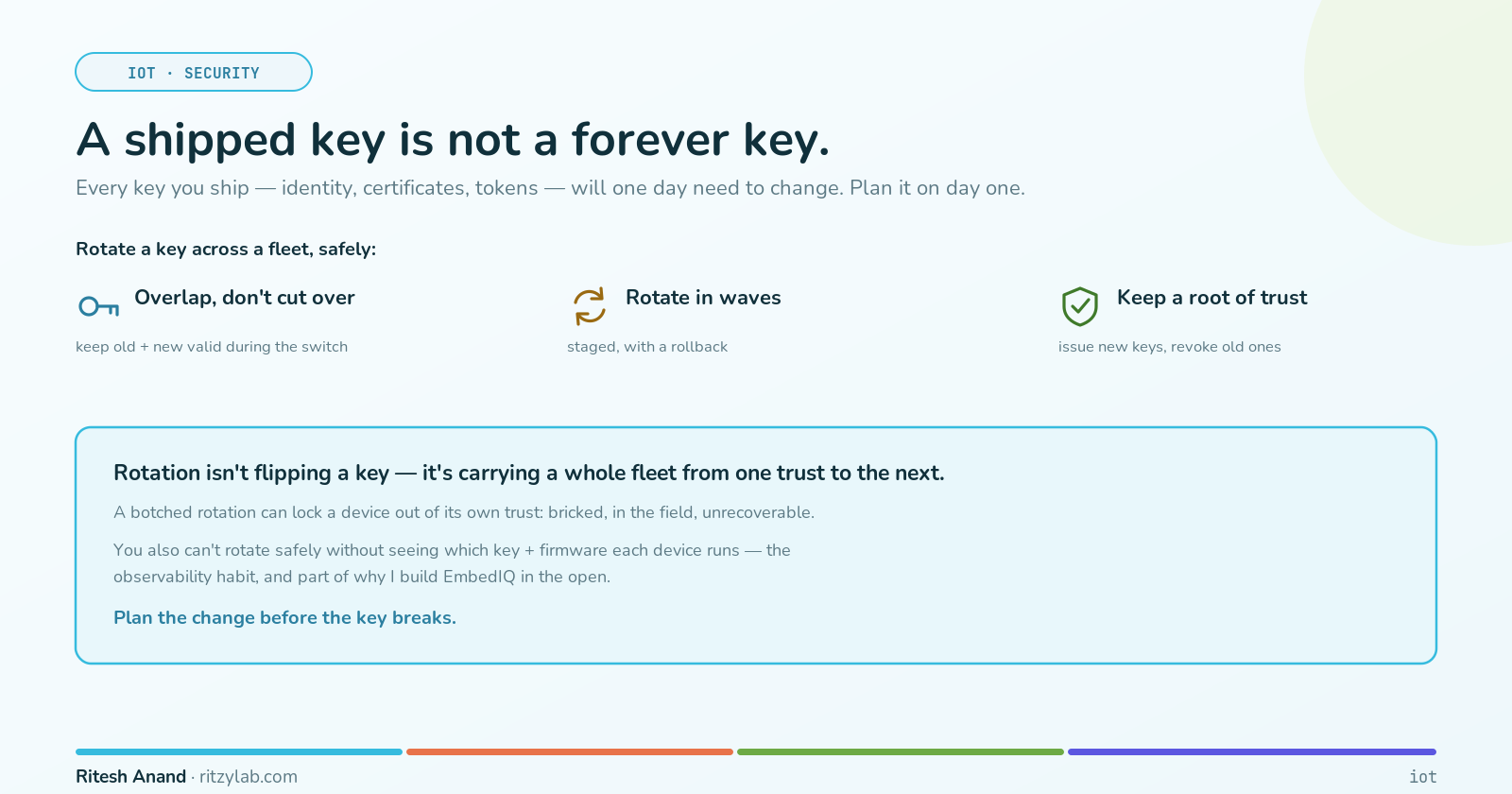
Worse, key rotation is one of the few operations that can lock a device out of its own trust. Push a new key or certificate incorrectly and the device can end up unable to authenticate, unable to accept the fix, and unrecoverable in the field. The safe pattern is the same discipline as a good firmware rollout: keep the old key and the new key both valid during an overlap window, rotate in waves rather than all at once, and keep a rollback so a bad batch stops at a few devices instead of the whole fleet. (It's the same logic as canarying a fleet update — never move everyone at once.)
▸ First principle. Rotation isn't flipping a key — it's carrying a whole fleet from one trust to the next without dropping any.
3. Design for rotation on day one — and know where every device stands
Because rotation is hard to retrofit, the work happens before you ship. Build the path in from the start: a root of trust that can issue new keys, an architecture where no single key's compromise sinks the entire fleet, and a way to revoke a key that's gone bad. None of this can be added convincingly after the fact, because the devices already in the field are the ones you'd need to change.
And there's a prerequisite that's easy to miss: you can't rotate safely if you can't see which key and which firmware each device is currently on. A rotation is a migration, and you can't run a migration blind. That's the same observability habit that shows up everywhere in fleet work — knowing the real state of each device before you act on it — and it's part of why I build EmbedIQ, my open framework for embedded and edge, around seeing what a device actually is and does. Rotation itself is a design responsibility of the product; observability is what makes doing it safely possible.
▸ First principle. The time to design key rotation is before the first unit ships, not after the first key breaks.
Sources
The practices here — key and certificate lifecycles, overlap windows, staged rotation with rollback, roots of trust, and revocation — are standard cryptographic key-management and IoT security guidance (for example, NIST's key-management recommendations and general secure-device-lifecycle practice). This piece is method and lived experience; it contains no product performance figures, and no specific vendor claims. The EmbedIQ capability referenced is limited to observability (seeing which key and firmware a device runs); key rotation itself is described as a product design responsibility, not a shipped EmbedIQ feature.
FAQ
Why do IoT devices need key rotation?
Because the cryptographic keys and certificates a device ships with don't last forever: they can be compromised, expire, or rely on algorithms that age out. A device deployed for years will outlive at least one of its keys, so it needs a safe way to change them — planned before it ships, not improvised after.
Why is rotating keys across a fleet risky?
A fleet is never uniform — devices are offline, on old firmware, or unreachable, and they don't all update at once. A single synchronized cutover strands the ones that miss it, and a botched rotation can lock a device out of its own trust, leaving it bricked and unrecoverable in the field.
How do you rotate keys safely across many devices?
Keep the old and new keys both valid during an overlap window instead of a hard cutover, rotate in waves with a rollback so a bad batch stops early, keep a root of trust that can issue and revoke keys, and make sure you can see which key and firmware each device is on before you act.
When should you design for key rotation?
Before the first unit ships. A rotation path — root of trust, no single fleet-sinking key, revocation, and per-device visibility — can't be added convincingly after deployment, because the devices already in the field are the ones you would need to change.
This is an IoT security field note. If you're deciding how to build a rotation path into a device before it ships, the longer story and how I work live on my profile. — Ritesh | ritzylab.com
Stay in the loop
New essays on embedded systems, firmware quality, and engineering craft. No noise.
Discussion
No comments yet. Be the first to share your thoughts.
Leave a comment