What this is. Opinion + Experience + Fact (55% opinion · 20% experience · 25% fact). Written in collaboration with AI — I discuss, I do not outsource.
A field note ahead of embedded world North America (September 22–24, 2026, Anaheim). The short version: embedded and edge have quietly become their own center of gravity in engineering, a dedicated show is the signal, and the value in a connected product has moved into software. Here's what I'll be watching, and why it matters even if you never set foot on the floor.
For a long time, embedded engineering lived in the corners of other people's events — a cluster of booths off to the side of the "real" computing or electronics show, a track that the keynote never quite mentioned. So it's worth noticing when the field gets a major stage of its own. embedded world North America runs September 22–24, 2026, at the Anaheim Convention Center, and whether or not you attend, a dedicated show is a signal about where engineering gravity has moved.
I read it simply: the devices around us — cars, meters, medical equipment, industrial systems, the whole connected-product world — are where an enormous share of real engineering now happens, and the discipline behind them has grown big enough to stand on its own. This is an opinion piece about what that shift means and what I'll be watching for.
1. A field with its own room has stopped being someone else's feature
When a discipline is small, it borrows space — a track here, a pavilion there, inside a bigger tent. When it gets its own room, something has changed: there's enough depth, enough audience, and enough money in motion to justify a show built entirely around it. That's the story embedded and edge have been quietly writing for a decade, and a dedicated North American event is a visible marker of it.
It matters beyond the trade-show calendar because it reflects where careers, budgets, and hard problems are concentrating. Embedded is no longer a subsection of electrical engineering or a footnote to the cloud; it's the place where a huge amount of the world's actual engineering gets done.
▸ First principle. When a field gets its own room, it has stopped being a corner of someone else's.
2. What I'll be watching for
The interesting thing about a show isn't the individual products — it's the pattern. When you step back, the floor tells you which problems the whole industry independently decided are worth money this year. My shortlist:
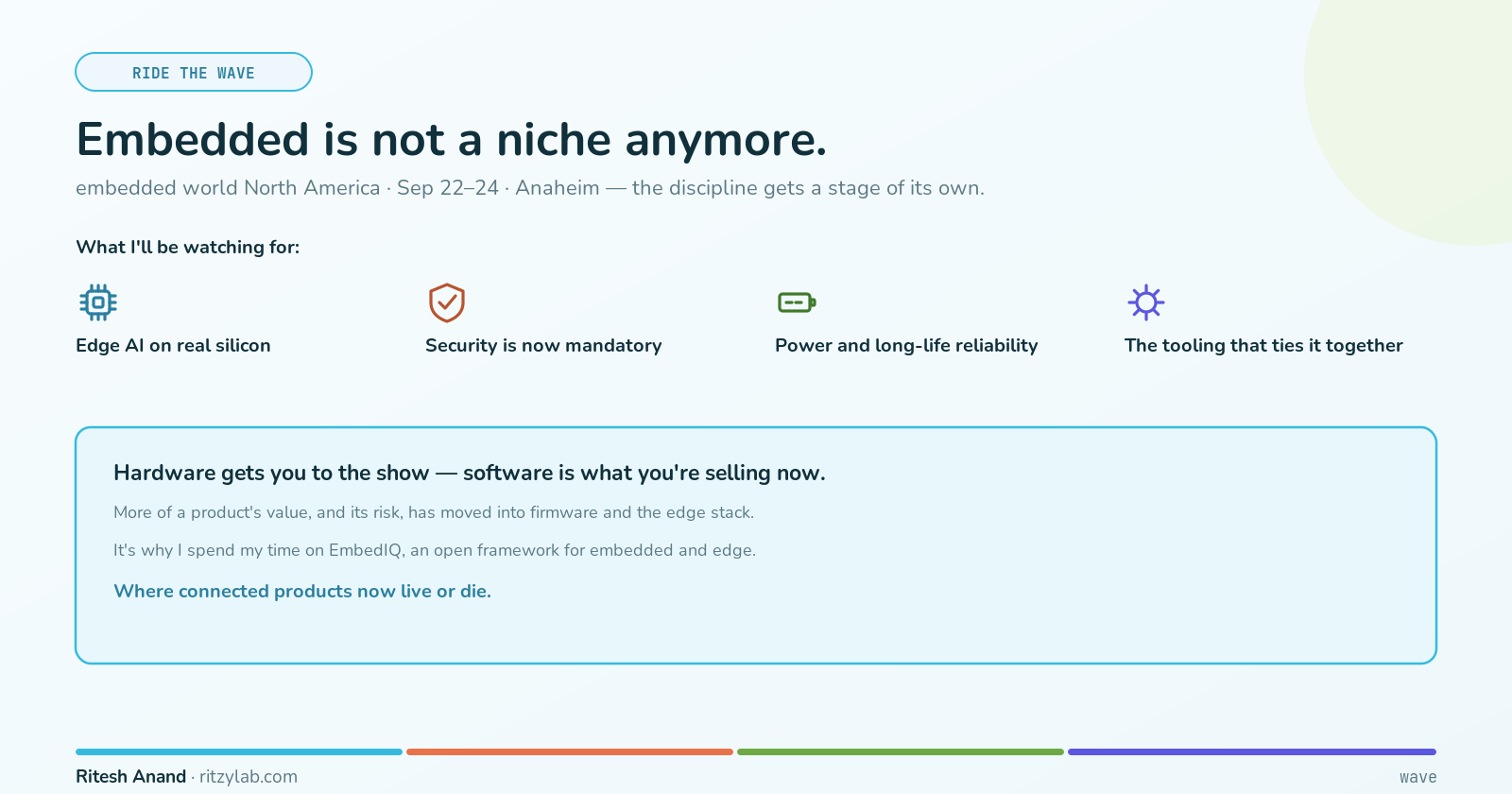
Edge AI on real silicon — models actually running on-device, within real power and memory budgets, not a cloud demo in disguise. Security and the regulation wave — with frameworks like the EU Cyber Resilience Act (the "CRA era"), security is moving from a nice-to-have to table stakes for anything that ships. Power and long-life reliability — devices that have to run for years, unattended, on a tight energy budget. And the tooling that ties it together — build, observe, update, and secure, as one workflow rather than four disconnected ones. None of these are novelties anymore; they're the line items connected-product teams are budgeting for right now.
▸ First principle. The signal at a show isn't the products — it's which problems everyone independently decided matter.
3. The thread underneath all of it
Pull on any of those threads and you reach the same place: more of a product's value, and more of its risk, has moved into software — into firmware and the edge stack. The hardware still has to be excellent, and it's what gets you in the door. But increasingly the software is what decides whether the product survives contact with the field: whether it stays secure for years, updates safely, sips power, and can tell you what it's doing when something goes wrong.
That's the reason I spend my time on EmbedIQ, an open framework for embedded and edge — the layer where connected products now live or die. A show like this is a good moment to step back and notice how much of the outcome has migrated there. (It's the same reason firmware is not just software.)
▸ First principle. Hardware gets you to the show; software is what you're actually selling now.
Sources
Event details (dates and location) confirmed from the official embedded world North America site: September 22–24, 2026, Anaheim Convention Center. This piece is opinion and lived experience about the direction of the field; it makes no attendance or numerical claims beyond the verified event dates and location.
FAQ
When and where is embedded world North America 2026?
September 22–24, 2026, at the Anaheim Convention Center in Anaheim, California. It's a trade show and conference focused on the embedded and edge computing community.
Why does a dedicated embedded show matter?
Because a field getting its own major event is a signal that it has become its own center of gravity — enough depth, audience, and investment to stand on its own rather than as a track inside a larger show. It reflects where engineering budgets and hard problems are concentrating.
What are the big themes in embedded and edge right now?
Edge AI running on real silicon within power and memory limits; security and regulation (such as the EU Cyber Resilience Act) becoming mandatory rather than optional; power efficiency and multi-year field reliability; and unified tooling to build, observe, update, and secure devices.
Why is software becoming the center of connected products?
Because more of a product's value and risk now lives in firmware and the edge stack. Hardware gets the product in the door, but software increasingly decides whether it stays secure, updates safely, lasts on its power budget, and can be debugged in the field.
This is a Ritzy Lab field note. If you're building in embedded or edge and want to compare notes, the longer story and how I work live on my profile. — Ritesh | ritzylab.com
Stay in the loop
New essays on embedded systems, firmware quality, and engineering craft. No noise.
Discussion
No comments yet. Be the first to share your thoughts.
Leave a comment