What this is. Opinion + Experience + Fact (30% opinion · 40% experience · 30% fact). Written in collaboration with AI — I discuss, I do not outsource.
Why connected-product timelines so often slip in the firmware phase — and what actually moves the date. The short version: most of the delay isn't hard problems, it's re-solving the solved ones under a deadline. Here's how to spend your calendar on the product instead of the plumbing, and how we help teams ship in weeks, not months.
If you're building a connected product, the timeline has a hardware date, and firmware inherits it. That's where "we just need a few more weeks" tends to come from — over and over. It's rarely because the team is slow. It's because most programs quietly rebuild the same device foundation from scratch, every time, under a clock. This is the quiet work we do at Ritzy Lab, so let me lay out why the slip happens, what removes it, and how experience changes the outcome.
1. The slip isn't the team — it's the rebuild
In connected-product development, the schedule is usually set by hardware milestones, and firmware picks up the accumulated pressure at the end of the line. Industry write-ups on 2026 development bottlenecks describe it plainly: firmware teams are chronically stretched, schedules assume software can be written faster than it can, and the result is firmware that works in the lab and struggles in the field. None of that is a knock on the engineers — good teams doing careful work still lose the same weeks.
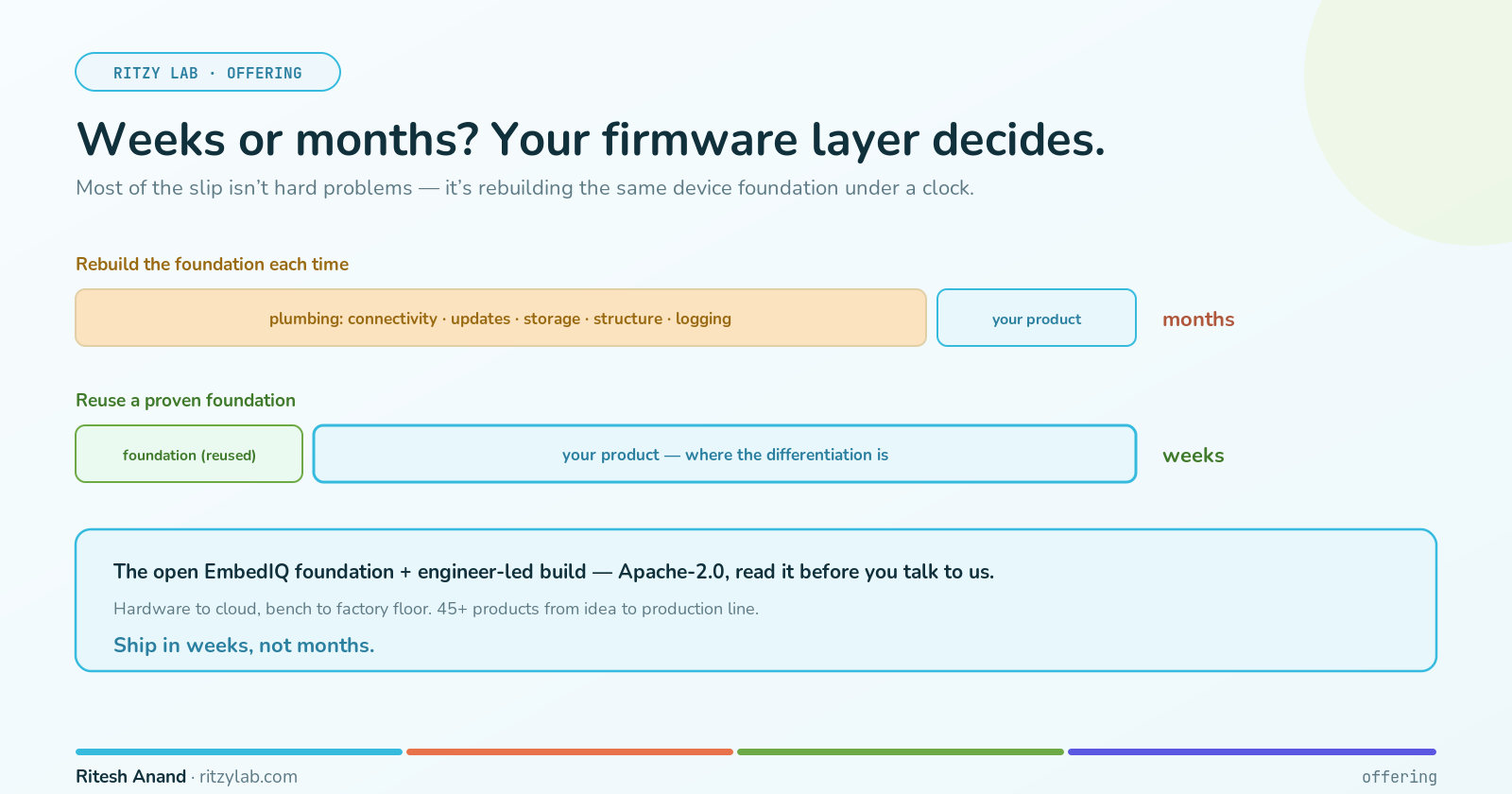
And here's the part that's genuinely avoidable: a large share of those weeks go into re-writing infrastructure that is nearly identical on every product — connectivity, over-the-air updates, persistent storage, task structure, logging. It's the same foundation each time, rebuilt from a blank main() under deadline. The novel, valuable part of your product waits in line behind plumbing the whole industry has already solved.
▸ First principle. Most firmware delay isn't hard problems; it's re-solving the solved ones under a clock.
2. Start from a foundation, and spend your weeks on what's new
The fix is structural, not heroic: don't start every product from a blank slate. Begin from a proven, reusable device layer — one with a clear structure and observability built in — so the team's time goes to what is genuinely new about your product rather than the scaffolding every product shares. When the foundation is already there and already trustworthy, the calendar stops being eaten by plumbing.
That foundation is what we build in the open as EmbedIQ — an Apache-2.0 framework for embedded and edge. It gives a device a clear structure (isolated units communicating through typed messages) and a zero-instrumentation way to see what actually happened at runtime. Because it's open, you can read it and run it before you ever trust us — no lock-in, no black box. It pairs naturally with the discipline behind knowing your fleet is healthy once the product is in the field.
▸ First principle. Reuse the foundation, and the calendar goes to the product, not the plumbing.
3. Put the factory-floor lessons in the room early
There's a second reason connected-product timelines slip: a connected product isn't finished at "it works on the bench." It's finished when a factory can build it at volume and it lasts in the field — and the gap between those two is where late, expensive surprises live. Design-for-manufacture, test at scale, thermal and power under real conditions, certification: each of these can force a respin if it's discovered late.
The way to shrink that risk is to have the experience in the room before the decisions are locked, not after. We've taken 45+ products from idea to production line — hardware to cloud, bench to factory floor — so the lessons that usually cost a respin are already informing the design. That's the difference between finding a manufacturing constraint at the PCB stage and finding it after tooling. (It's the same message as going from a working bench prototype to a factory building 10,000.)
▸ First principle. Experience that's been to the factory floor turns late surprises into early, deliberate choices.
4. How we help — weeks, not months
This is what Ritzy Lab does: we pair the open EmbedIQ foundation with engineer-led build, so a connected product spends its schedule on what's new instead of rebuilding the shared layer — and so the factory-floor lessons are in the design from the start. The result we aim for is the spine of everything we do: build your product in weeks, not months. And because the foundation is open source, you can verify it before we ever talk — which is exactly how it should be.
▸ First principle. The fastest path to a shipped connected product is a proven foundation plus people who have shipped one before.
Sources
On firmware as the structural bottleneck in connected-product development — stretched firmware teams, hardware-driven schedules, lab-vs-field gaps, and cross-disciplinary coupling — see 2026 industry analysis: Promwad, "Cross-Disciplinary Engineering Teams in Embedded Product Development" and Zeus Design, "Embedded Software Solutions for Hardware Products in 2026." This piece describes method and lived experience; the only figure is "45+ products," which is our own track record.
FAQ
Why do connected-product timelines slip in the firmware phase?
Because the schedule is usually set by hardware milestones and firmware inherits the pressure at the end, and because most programs rebuild the same device infrastructure — connectivity, OTA updates, storage, structure, logging — from scratch each time. The delay is largely re-solving already-solved problems under a deadline, not the team being slow.
How do you speed up embedded/firmware development?
Start from a proven, reusable device foundation with clear structure and built-in observability, so engineering time goes to what's new about the product instead of the shared plumbing. Pair it with people who have taken products to production before, so manufacturing and field lessons shape the design early rather than forcing a late respin.
Should we build our firmware foundation from scratch or reuse one?
Reuse where you can, and spend your time on what's differentiated. The structure, storage, connectivity, and update layers look nearly identical across connected products, so rebuilding them from a blank slate each time spends your calendar on plumbing. The open Apache-2.0 EmbedIQ framework gives you the device structure and runtime observability in the open; pairing that with an engineer-led build of the rest means you start from a proven base, not a blank slate — and because it's open, without lock-in.
What does Ritzy Lab do for connected-product teams?
We pair the open EmbedIQ foundation with engineer-led build — hardware to cloud, bench to factory floor — to help teams ship connected products in weeks, not months. Because the foundation is open source, you can read and run it before engaging us.
This is a Ritzy Lab field note. If a connected-product timeline is drifting and you want a second set of eyes, the longer story and how we work live on my profile. — Ritesh | ritzylab.com
Stay in the loop
New essays on embedded systems, firmware quality, and engineering craft. No noise.
Discussion
No comments yet. Be the first to share your thoughts.
Leave a comment