What this is. Opinion + Experience + Fact (45% opinion · 30% experience · 25% fact). Written in collaboration with AI — I discuss, I do not outsource.
Part of the AI Builder series — the first chapter of the second half. You've built the product; now you have to run it as a business, and it starts with the question builders skip: who is this for, and why you? Here's the audience-and-positioning layer — why "everyone" is a trap, what positioning actually is, and how to use AI on it without inventing a market.
Everything in this series so far had a map. Mechanical, electronics, firmware, connectivity, manufacturing — hard, but charted. You can look up how a PCB is laid out or what PVT proves. Now the other half begins, and nobody hands you a diagram for it: running the thing as a business. It's the half that decides whether all that building ever reaches a customer, and it opens with the move most builders rush past because it feels soft next to the "real" engineering — deciding exactly who the product is for, and why someone should pick you.
This is the AI Builder series crossing into the half nobody maps, starting with audience and positioning. As with the rest of the series, you don't need to become a marketer — you need enough awareness to ask the sharp questions and catch a wrong answer, including from an AI that will happily describe a market that doesn't exist.
1. "Everyone" is not an audience
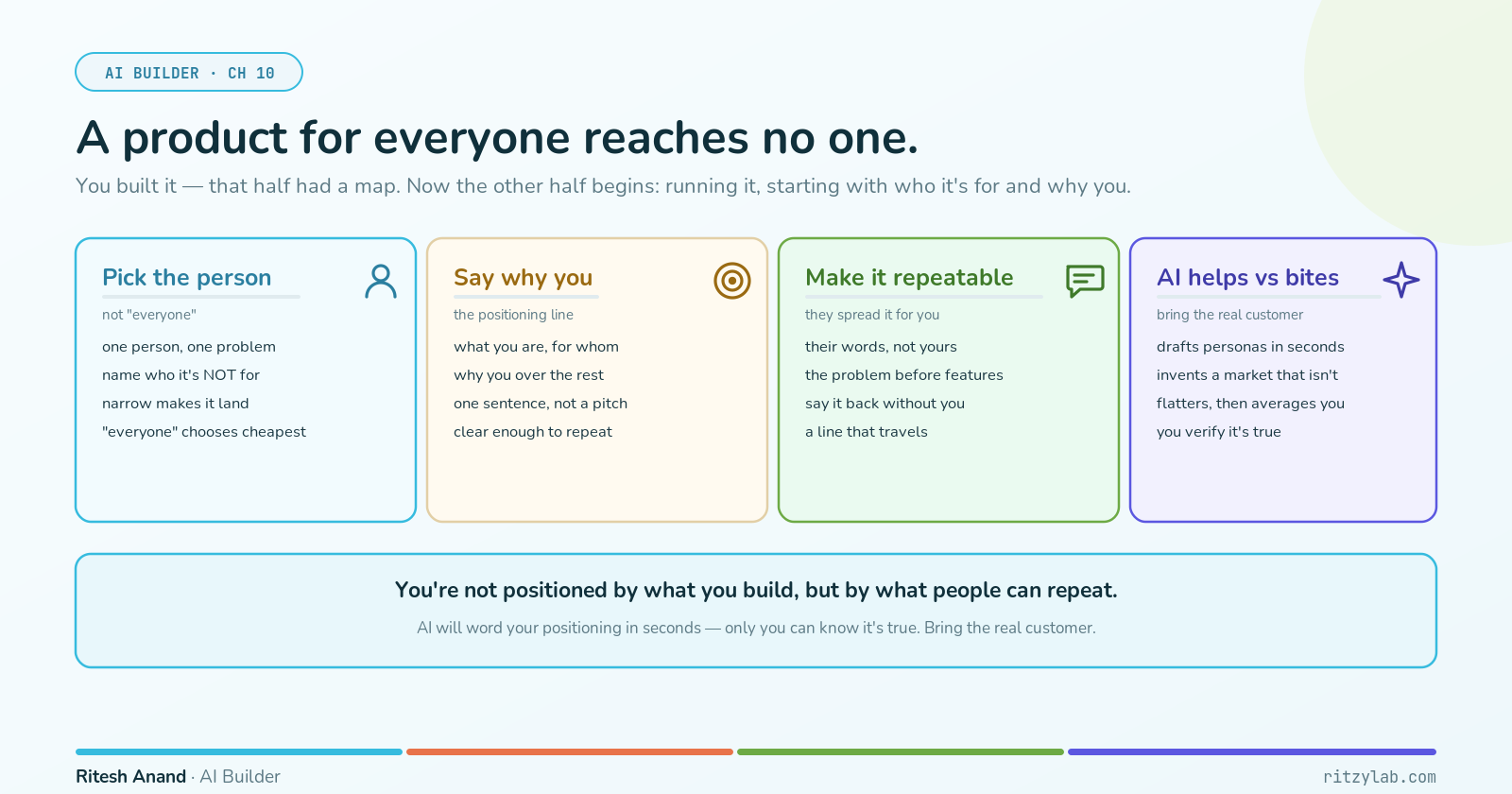
The instinct, especially for a builder proud of a flexible product, is to keep the audience wide: it's for everyone, why would I turn anyone away? But "everyone" isn't a person, and people don't buy from products aimed at no one in particular — they buy from the one that clearly gets them. When you picture a specific person with a specific problem, every later decision gets easier: what to say, which features to lead with, where to show up, what to charge. Counterintuitively, naming who the product is not for is what makes it land hard for the people it is for. A product for everyone competes only on price and volume; a product for someone competes on fit.
▸ First principle. The narrower the person you picture, the sharper everything else gets.
2. Positioning is the sentence they repeat for you
Positioning isn't a slogan or a logo — it's the answer to "what is this, who is it for, and why is it the better choice for them?" compressed into something a customer can say back to a colleague when you're not in the room. That last part is the test. Most growth early on isn't your marketing; it's one person explaining your product to another. If your positioning takes a paragraph and a demo to convey, it won't survive that retelling. If it fits in a sentence built from the customer's own words and their problem — not your feature list — it travels on its own. You are not positioned by what you build; you're positioned by what people can repeat.
▸ First principle. You're not positioned by what you build, but by what people can repeat.
3. Awareness, not mastery — and where AI helps vs bites
You don't need to be a positioning consultant. You need enough awareness to ask three questions and know a weak answer when you hear one: who exactly is this for, what do they already believe about their problem, and why me over the alternative they'd otherwise choose (including doing nothing)?
AI is genuinely useful here and genuinely dangerous. It will draft personas, a positioning statement, and a dozen taglines in seconds — and it will just as readily invent a target market that isn't there, flatter your idea because you clearly like it, and average your positioning into the same bland language every competitor uses. It has read everyone's marketing, so left alone it regresses you to the mean. The fix is the discipline that runs through this whole series: bring the real customer — actual conversations, actual objections, the actual alternative they use today — or the model fills the vacuum with confident, generic fiction. AI can word your positioning; only you can know it's true.
▸ First principle. AI can word your positioning, but only you can know it's true.
A prompt you can actually use
Force AI to expose its assumptions about your market before it writes a single confident sentence about it.
You are helping me position [product], which does [what it does].
Before writing any positioning or taglines, list:
1. Who you think the specific target customer is — and who it is NOT for.
2. What that customer likely already believes about this problem.
3. The real alternative they use today (including doing nothing).
4. Why they'd choose this over that alternative.
CHECK: mark every item [known from what I told you] or [GUESSED]. Ask me for the guesses before proposing positioning.
▸ First principle. Make AI declare who it's guessing about, and its confidence stops passing for knowledge.
Keywords
audience definition, positioning, positioning statement, target customer, ideal customer profile, go-to-market, messaging, differentiation, AI for marketing, AI Builder series.
FAQ
Why is targeting "everyone" a mistake?
Because "everyone" isn't a person, and people buy from products that clearly understand their specific situation. A wide audience forces you to compete on price and volume; a specific audience lets you compete on fit. Naming who the product is not for is what makes it resonate for the people it is for.
What is positioning, exactly?
Positioning is the answer to what a product is, who it's for, and why it's the better choice for them — compressed into a sentence a customer can repeat to someone else without you present. It's not a slogan or a logo; it's the idea that travels when someone recommends you.
How do you use AI for positioning without going generic?
Make it declare its assumptions first: who the target is and isn't, what they already believe, the real alternative they use, and why they'd switch — each marked known or guessed. AI has read everyone's marketing and will average you into the same language unless you supply the real customer: actual conversations, objections, and alternatives.
Do I need marketing expertise to position my product?
No — you need awareness, not mastery: enough to ask who exactly it's for, what they believe, and why you over the alternative, and enough to recognize a vague answer. Those questions are most of the value and are learnable.
Part of the AI Builder series — it compiles into the Handbook. The longer story and how I work live on my profile. — Ritesh | ritzylab.com
Stay in the loop
New essays on embedded systems, firmware quality, and engineering craft. No noise.
Discussion
No comments yet. Be the first to share your thoughts.
Leave a comment