What this is. Opinion + Experience + Fact (45% opinion · 25% experience · 30% fact). Written in collaboration with AI — I discuss, I do not outsource.
Part of the AI Builder series. The prototype proved the idea; now a factory has to build thousands that all work. Here's the manufacturing-and-supply-chain layer — why it's a different discipline, the stages that de-risk it, and how to use AI on it without shipping a beautiful design a factory can't build.
There's a gap in every hardware project that looks small from the prototype side and enormous from the factory side. On the prototype side you have one unit that works. On the factory side you need thousands of identical units that all work, roll off a line on schedule, cost little enough to leave a margin, and survive years in the field. Making one is not making ten thousand — and the distance between them is manufacturing, the discipline that quietly kills more good hardware than any bug.
This is the AI Builder series reaching manufacturing and supply chain — the product that just grew a brain and a connection now has to be built at volume. As with the rest of the series, you don't need to be a manufacturing engineer — you need enough awareness to ask the right questions and catch a wrong answer, including from an AI that will confidently design something no factory can actually build.
1. One that works is not a thousand that ship
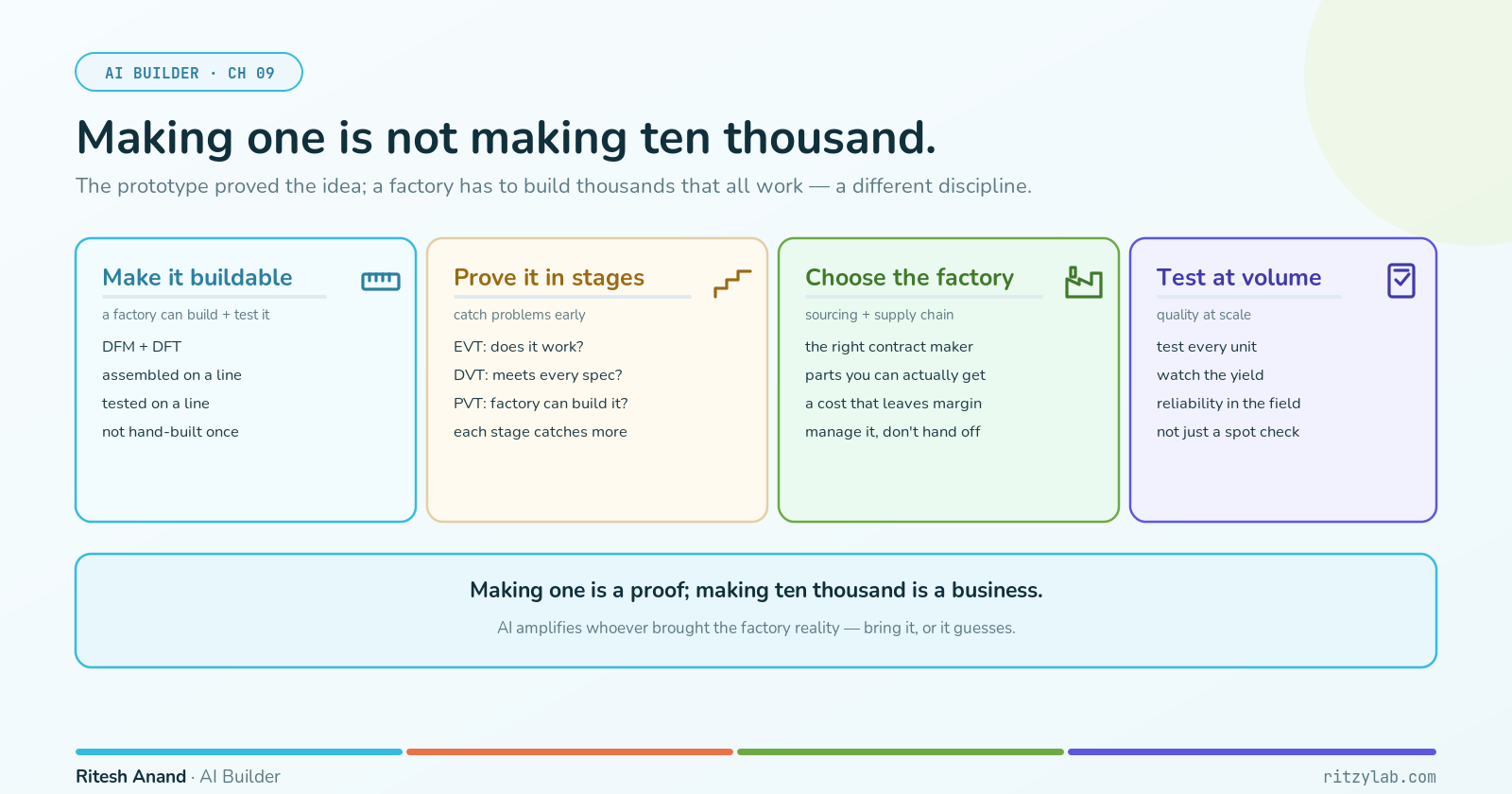
A hand-built prototype answers a single question: can this work at all? A production line answers a much harder set: can we build many identical units, reliably, affordably, on time — and can we keep doing it? Those are different problems, and the second is where promising products stall. It's tempting to treat manufacturing as a formality that happens after the "real" work; in practice the prototype is often the easy part, and build, cost, yield, and reliability are where the expensive surprises live. (It's the crossing from a working prototype to a factory building 10,000.)
▸ First principle. The prototype is the hypothesis; the production line is the proof.
2. Manufacturability is designed in, not bolted on
Whether a product can be built at volume is decided during design, not discovered at the factory. The tools are well established: design for manufacture and design for test (DFM/DFT) so the thing can actually be assembled and tested on a line; the staged validation builds — EVT (Engineering Validation Test: does it work?), DVT (Design Validation Test: does it meet every spec, reliably?), and PVT (Production Validation Test: can a factory build it at volume and quality?) — run in order so problems surface while they're still cheap; factory test systems; and choosing and managing the right contract manufacturer.
The economics are unforgiving: a constraint caught early is a small change, while the same constraint caught after tooling is a respin. Every week you delay finding a manufacturing problem multiplies what it costs to fix — which is why manufacturability has to be a design input from day one.
▸ First principle. The cost of a manufacturing surprise grows with how late you find it.
3. Awareness, not mastery — and where AI helps vs bites
Here's the useful part for a builder who isn't a manufacturing specialist. You need enough awareness to ask the sharp questions: can this be built at volume, tested on a line, and sourced from parts that actually exist? Those questions are most of the value, and they're learnable.
AI is both a real accelerator and a real hazard here. It will draft a DFM checklist, a test plan, or a bill of materials in seconds — and just as quickly assume a component is available when it's on a 40-week lead time, ignore a mechanical tolerance, or skip a certification your market requires. The fix is the same discipline as everywhere in this series: bring the real constraints — the target cost, the volumes, the parts you can source, the certifications, the tolerances — or the model fills the gaps with confident fiction.
▸ First principle. In manufacturing, AI amplifies whoever brought the factory reality — bring it, or it guesses.
A prompt you can actually use
Force AI to surface the manufacturing reality — and its own guesses — before it hands you a plan.
You are helping me take [product] from prototype to volume production of [quantity].
Before proposing anything, list:
1. DFM/DFT risks — what about this design is hard to build or test on a line?
2. The EVT / DVT / PVT plan — what each stage must prove for this product.
3. Sourcing risks — parts with long lead times, single sources, or availability doubts.
4. Cost drivers and the certifications this product needs for its market.
CHECK: mark every claim [known] or [GUESSED], and flag anything you assumed. No plan until I confirm.
▸ First principle. Make AI declare the factory constraints before it plans, and its confidence stops being a risk.
Keywords
prototype to production, design for manufacture (DFM), design for test (DFT), EVT DVT PVT, contract manufacturing, supply chain, yield, hardware at volume, AI for manufacturing, AI Builder series.
FAQ
Why is manufacturing a different discipline from prototyping?
A prototype answers "can it work?" for one hand-built unit. Manufacturing answers "can we build thousands that are identical, reliable, affordable, and on time — repeatedly?" Those are different problems, and the second is where most promising hardware stalls.
What are EVT, DVT, and PVT?
Staged validation builds: EVT (Engineering Validation Test — does it work?), DVT (Design Validation Test — does it meet every spec reliably?), and PVT (Production Validation Test — can a factory build it at volume and quality?). Running them in order catches problems while they're still cheap to fix.
How do you use AI safely for manufacturing?
Make it state the constraints and its guesses first: DFM/DFT risks, the EVT/DVT/PVT plan, sourcing and lead-time risks, cost drivers, and required certifications — each marked known or guessed. AI is great at drafting these but will confidently assume parts are available or ignore tolerances if you don't supply the real constraints.
Do I need to be a manufacturing engineer to take a product to volume?
No — but you need awareness, not mastery: enough to ask whether the design can be built at volume, tested on a line, and sourced, and enough to catch a wrong answer. That awareness is most of the value and is learnable.
Part of the AI Builder series — it compiles into the Handbook. The longer story and how I work live on my profile. — Ritesh | ritzylab.com
Stay in the loop
New essays on embedded systems, firmware quality, and engineering craft. No noise.
Discussion
No comments yet. Be the first to share your thoughts.
Leave a comment